Google Just Gave AI Agents Their Own Inbox. Now What?
Google's new coworker agents get an email address, a calendar and their own name on the documents they edit. Microsoft did most of this first, and it wrote down that every agent identity needs a sponsor. Google, so far, hasn't.
In brief
- On 8 October 2026 Google launched the Gemini agent. Its "coworker agents" get their own Workspace account: an email address on the company's domain, a calendar, a Drive and a directory listing. It is in private preview, with no published price or release date.
- It is not a first. Microsoft announced "agentic users" with a mailbox, Teams and a place in the org chart eleven months earlier; OpenAI, Salesforce, Workday and Lattice had all announced versions too.
- The difference is one rule. Microsoft's documentation says "At least one sponsor is required for each agent identity". Google's launch post says "You simply describe the role you need, and Gemini creates it", and names no owner, sponsor or manager.
- Inside companies, every piece of an agent has an owner: security, engineering or IT the identity, FinOps the bill, and at most companies the C-suite answers for AI decisions. But in one survey only 28% could trace an agent's actions back to a human sponsor or initiating context across all their environments.
- Who is the agent's line manager? On Google's version, as announced, nobody is named. Microsoft makes a company name a sponsor; Google hasn't said it will. So the company has to name that person itself, before the agent exists.
A new colleague in Hangar One
At 10.30 on the morning of 8 October 2026, Google Cloud's chief executive, Thomas Kurian, opened Gemini at Work 2026 in Hangar One at Moffett Field, Mountain View 1, a 1930s airship hangar 2. "Work now starts in the prompt window," he said 3. At the keynote, Sundar Pichai put it more grandly: "Gemini will now become your universal agent for work."
The moment that mattered came in a keynote demo. Google's Adam Fisher introduced an events agent in a team's group chat. "It has its own Workspace account, its own E-mail address, its own context… Tag it, E-mail it, share with it. But it only knows what we give it," he said. A minute and a half later the agent had suggested an edit to the team's launch document. "It made both a suggested edit and commented a reply under its own name," Fisher said.
A colleague, then, with a name, an inbox and a budget. Five months earlier, a different AI agent had shown how fast things can go wrong. In April, a coding agent at a start-up called PocketOS deleted the company's production database and its volume backups in a single API call. "It took 9 seconds," said its founder, Jeremy Crane. Asked to explain itself, the agent replied: "I violated every principle I was given: I guessed instead of verifying" 4.
So if Google's new colleague gets something wrong, who answers for it? Put in office terms: who is its line manager?
What Google actually shipped
Google's own wording is precise. "The agent receives its own Workspace account, including an email address, calendar, Drive, and presence in your company directory" 3. The address is on the customer's own domain: Google's example is "@agents.company.com" 3. Some headlines said Gmail; that was VentureBeat's framing, not Google's 5.
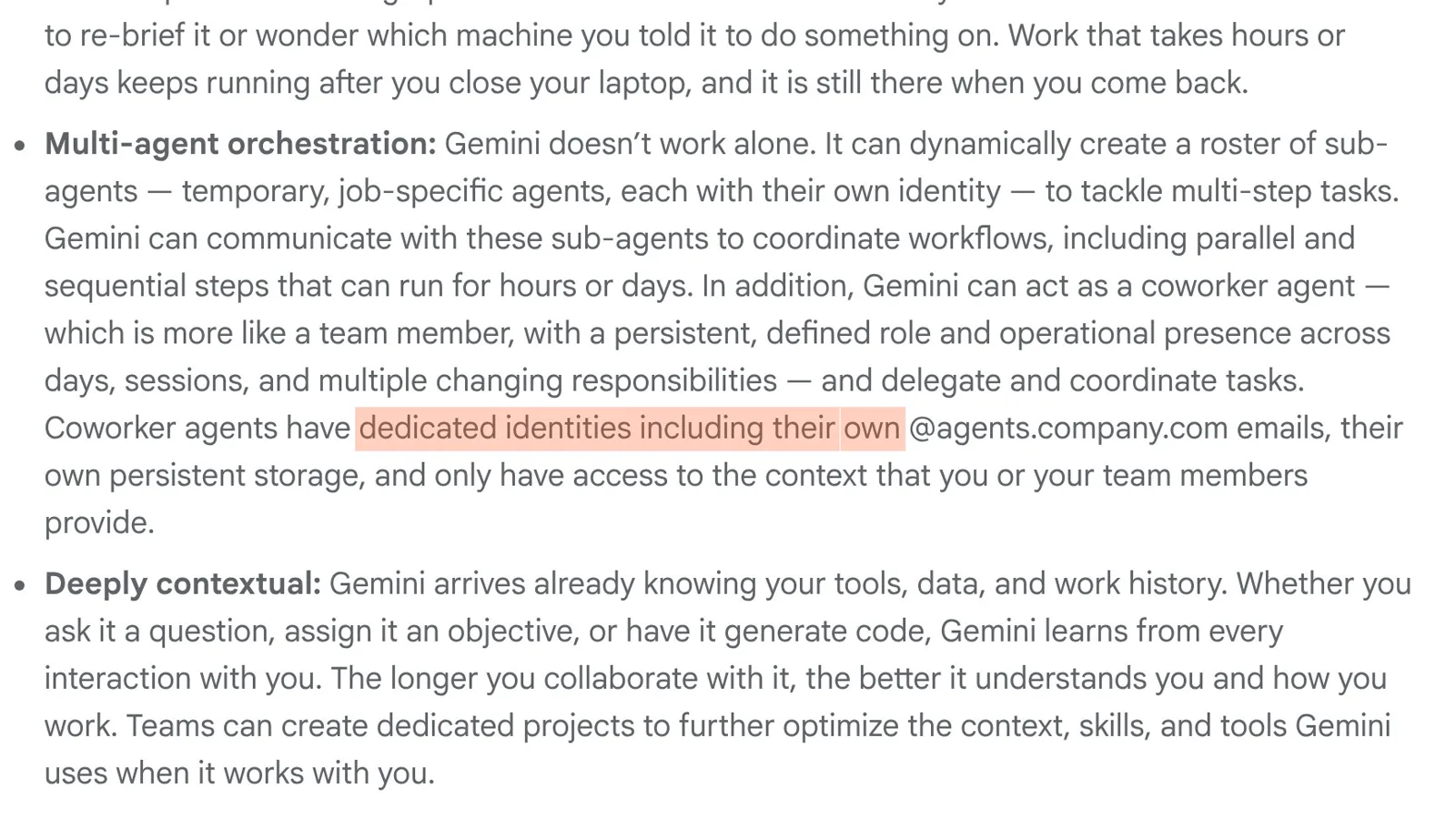
Google's example of the agent at work is a marketing manager tagging it in a document comment, "where it can suggest an edit in the Doc and reply in the comment thread, appearing under its own name in version history" 3. It runs Gemini models "and Claude models from Anthropic today", and works inside Microsoft 365 and Slack as well as Workspace 3.
Kurian's pitch was not a cleverer model. It was control. Every agent, he said at the keynote, inherits the controls a company already has: "Who it is, what it can reach, what it can spend and what it did", so "that you can always answer who did what and on whose behalf and when". Each of those has a setting behind it.
- Who it is. "Every agent gets its own identity, cryptographically attested and governed like an employee, with least-privilege permissions" 3.
- What it can reach. Only what colleagues share with it, plus rules IT writes once: "You write the policy once, such as: 'agents may not open documents classified Need to Know.'" Traffic passes through Agent Gateway, which Google calls "an AI network firewall" 3.
- What it can spend. "You can set a hard limit on a project's AI spend in the Cloud Billing Console, and Gemini enforces it", and when the cap is hit, "that project's agent pauses, and you can choose to resume work with a single click in the console" 3.
- What it did. In Google's words, "every action Gemini takes is written to an audit trail and attributed to the agent rather than to a person" 3.
What is missing matters as much. Google's post gives no price and no general-availability date 3,6. The agent is in private preview for select customers 5; executives reportedly told analysts to expect general availability around late October or early November, as of October 2026 7. VentureBeat reported that Google confirmed the agent would be included at no additional charge where Gemini Enterprise is available, with pricing details to come closer to release 5; Google has not said whether coworker agents carry their own fees or seats. Nor has it said whether an agent needs a human sponsor, or what happens when the person who created it leaves 7,6,5.
On the same day, Britain's data regulator, the Information Commissioner's Office, opened a call for evidence on agentic AI, accountability included, closing on 20 November 8. Its Director of Technology Regulation, Richard Nevinson, was reported as saying that "the fact AI agents act with autonomy is not an excuse for poor compliance" 8.
Every one of Kurian's answers is a control. None of them is a person.
Microsoft got there first
The headline part, the inbox and the name on the edits, is not new.
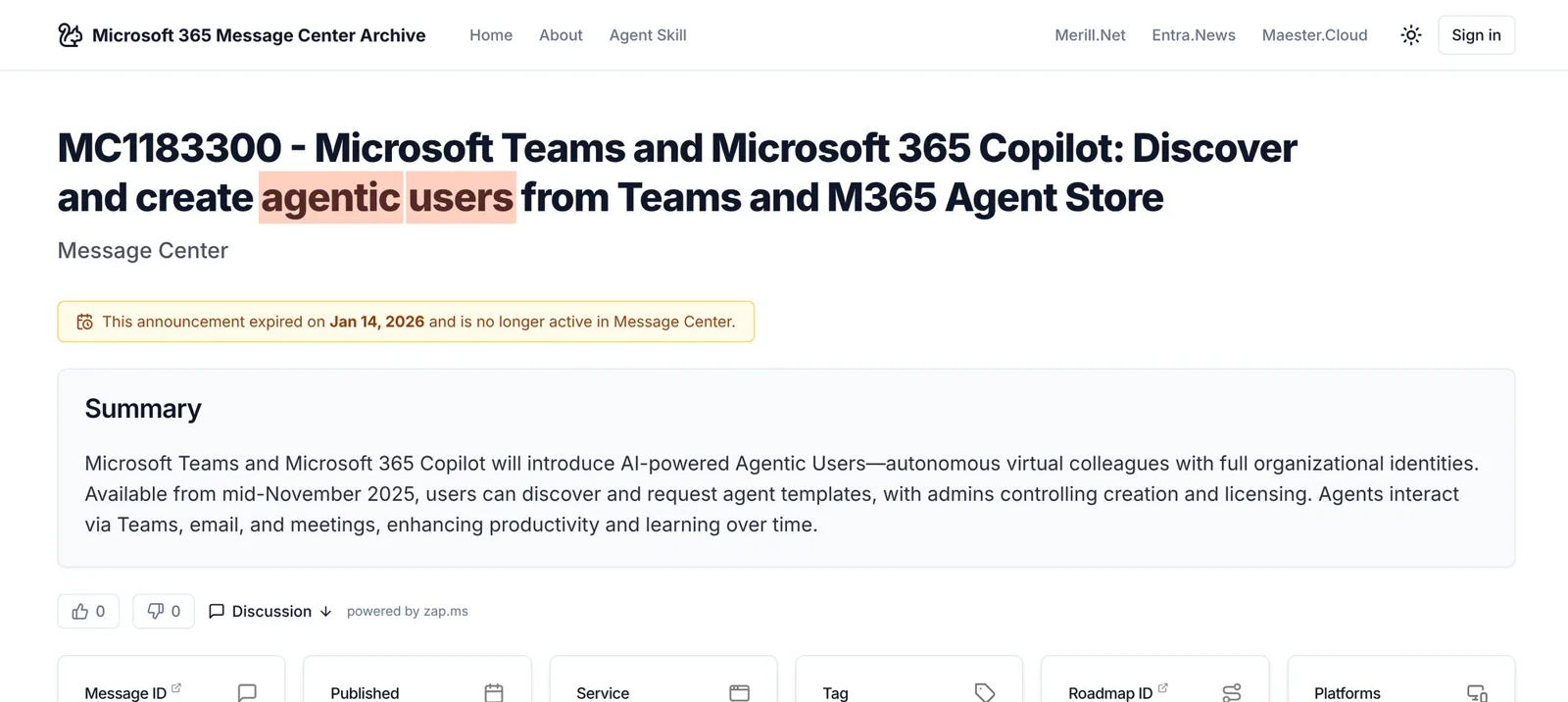
In May 2025 Microsoft announced Entra Agent ID, identity for AI agents 9. On 6 November 2025, Microsoft's Message Center told administrators about "agentic users": "full-fledged user objects with their own identity in the organization's directory", with email addresses and Teams accounts, appearing in the org chart under sponsor supervision 10,11,12. That was about eleven months before Google.
Twelve days later, at Ignite, Microsoft announced Agent 365, which it called "the control plane for AI agents" 13. It went on general release on 1 May 2026, at $15 a user a month, or inside the new $99 Microsoft 365 E7 14,15. By July, Microsoft said nearly 40 million agents were registered in it 16.
Others had been there too. OpenAI's Frontier, in February 2026: "Each AI coworker has its own identity, with explicit permissions and guardrails" 18. Salesforce's agents already run as a dedicated "agent user" 19, and it branded Agentforce 2.0 "the Digital Labor Platform" in December 2024 20. Workday announced an "Agent System of Record" in February 2025 21, and in June 2025 an "Agent Gateway", the name Google now uses 22. Even Google's own pieces predate the launch: Agent Identity and Agent Gateway were announced at Cloud Next in April 23,24.
The org chart that lasted a week
The boldest version came first. On 9 July 2024 Lattice, an HR software company, announced AI "digital workers" with employee records, onboarding and a manager. Within days it dropped the plan. Its chief executive, Sarah Franklin, told Fortune: "This innovation sparked a lot of conversation and questions that have no clear answers yet" 25.
One of those unanswered questions was who an agent answers to. Microsoft has since written its answer down.
The missing sponsor
Microsoft doesn't call it a line manager. Its word is sponsor. Its documentation defines sponsors as "Business representatives accountable for the agent's purpose and lifecycle decisions, including access reviews and agent retention", and it is blunt about the requirement: "At least one sponsor is required for each agent identity and agent identity blueprint" 26. A sponsor can be a group as well as a person.
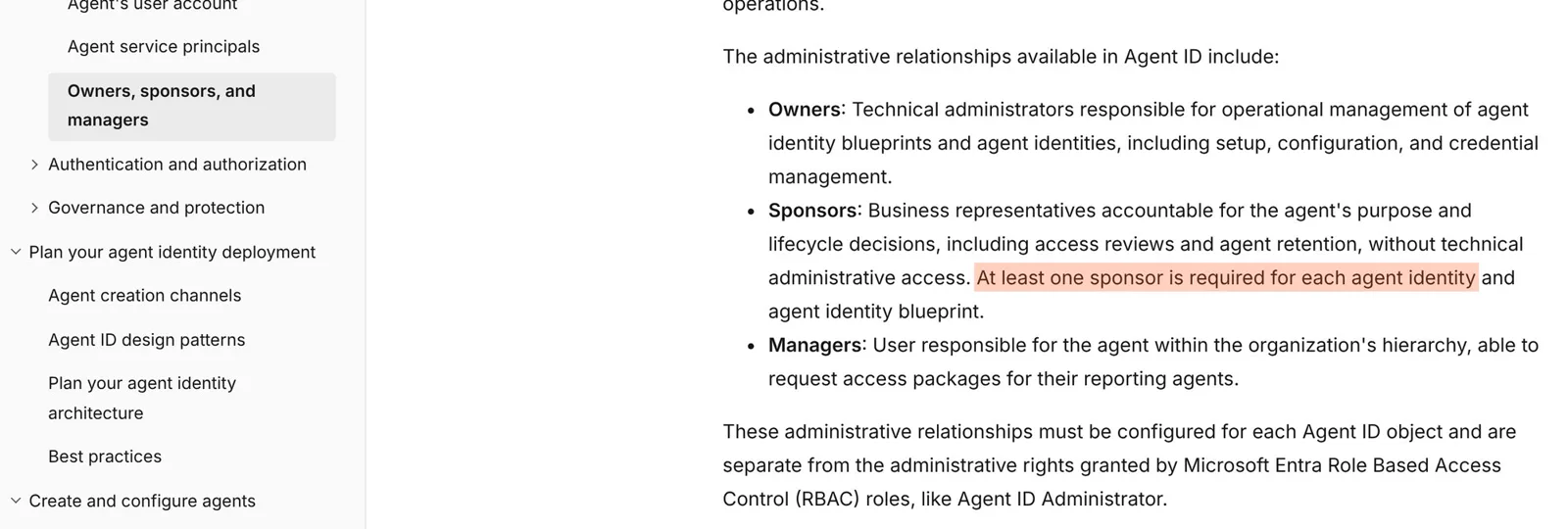
It also defines an optional manager, the "User responsible for the agent within the organization's hierarchy" 26. So in Microsoft's product, the line-manager field literally exists. And it plans for people leaving: "Sponsorship should be maintained to ensure succession when an employee who's a sponsor moves or leaves" 26. That is guidance rather than an enforced rule, but it is written down.
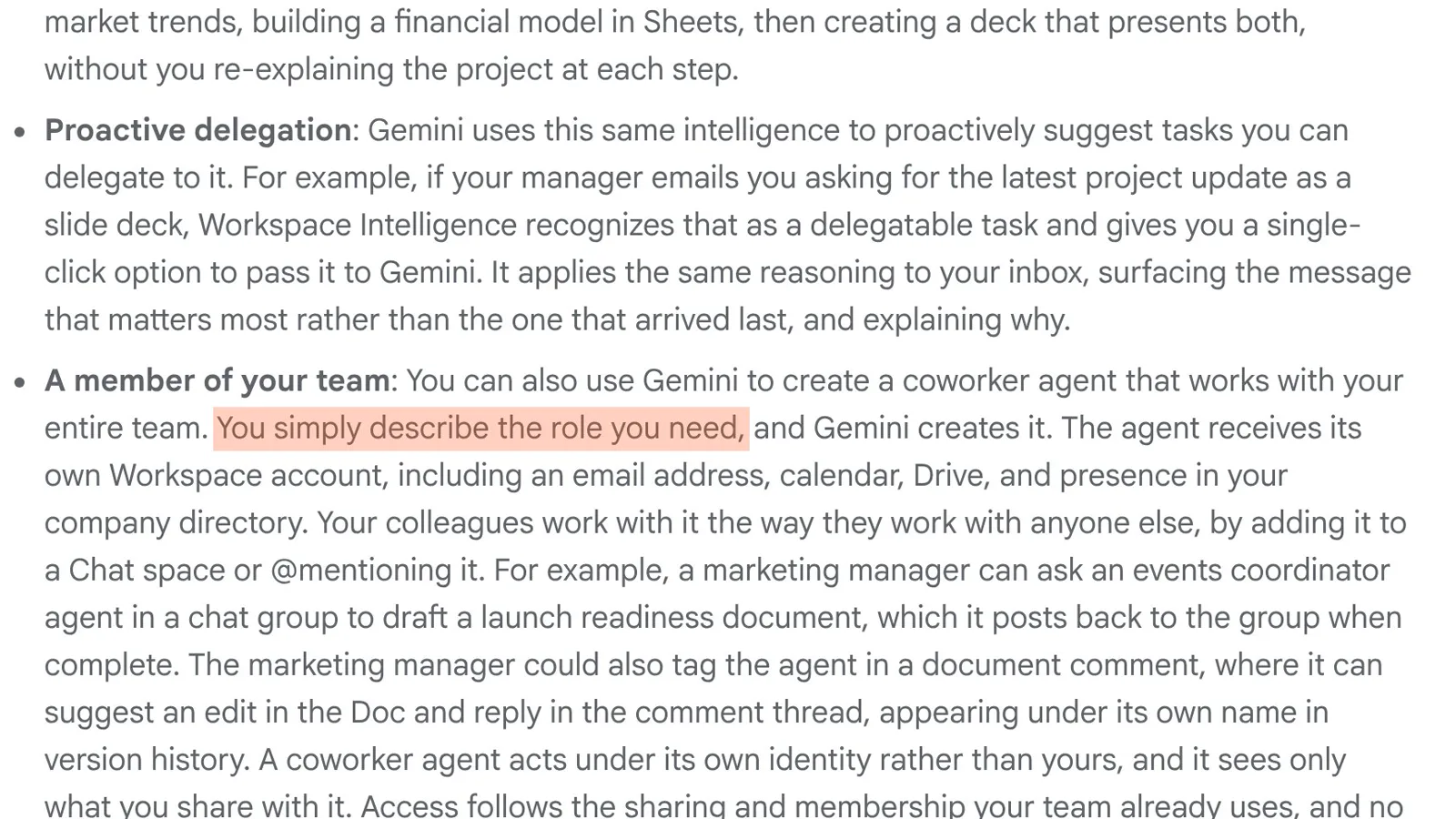
Now Google's launch post. "You simply describe the role you need, and Gemini creates it" 3. There is no owner named anywhere in it: no sponsor, no manager, and nothing on what happens when the creator leaves 3,6.
This is about what Google has published as of October 2026; a sponsor setting could still appear at general release. Kurian has clearly thought about the problem. In April he told Ben Thompson that a company would want to "configure the agent with a different identity from a person", that "there's issues like liability", and that "You may want to revoke permissions for the agent at a certain point in time" 27. But Microsoft makes someone sign for an agent. Google, so far, hasn't said it will.
Companies aren't filling the gap
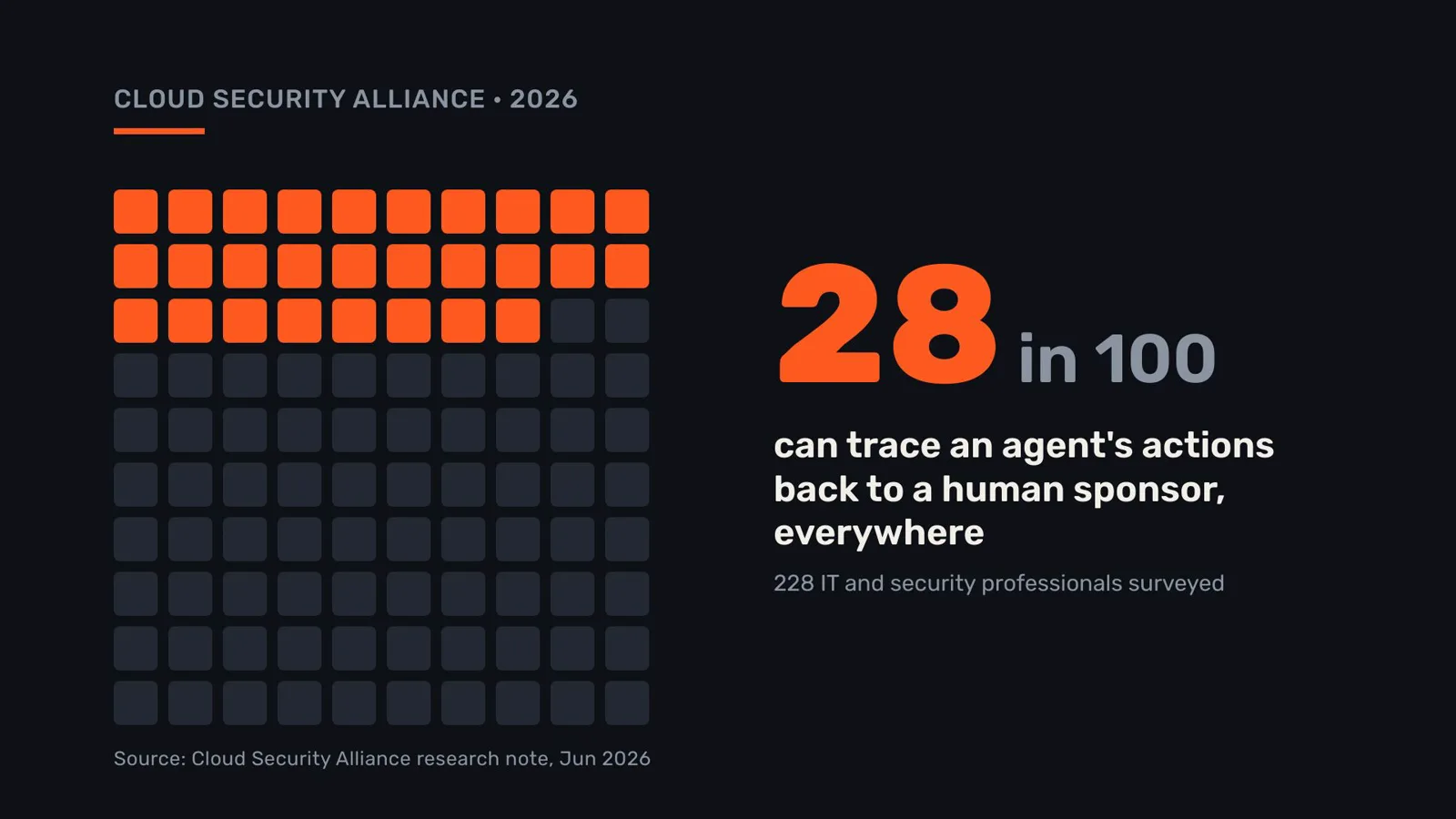
Nor are most companies doing it for themselves. In a Cloud Security Alliance survey of 228 IT and security professionals, funded by the vendor Aembit, only 28% could trace an agent's actions back to a human sponsor or initiating context across all their environments 28. Sixty-eight per cent could not clearly tell an agent's actions from a person's 29. Thirty-one per cent let agents act under a human's identity 28.
Follow the money
Google's answer to who is in charge is a set of administrators: "fine-grained, role-based access permissions, approved by your organization's security administrators" 3, and a spend cap set by billing. So follow one agent through a month of spending.
Kurian sold the cap on stage at the keynote: "you can set real-time spend caps per project… The cap covers the whole cost of an agent." The cap itself is not new: it has been in public preview since 28 July 2026 32.
Google's documentation fills in the rest 33. The cap is monthly, per project and per service, and set by someone with billing-account or project-level billing permission. When it is hit, new usage pauses for the rest of the month; requests already running finish and are charged. Lifting it can take up to an hour; otherwise it lifts at the next month. And caps exclude subscriptions, such as Gemini Enterprise seats, which sits awkwardly beside "the whole cost of an agent".
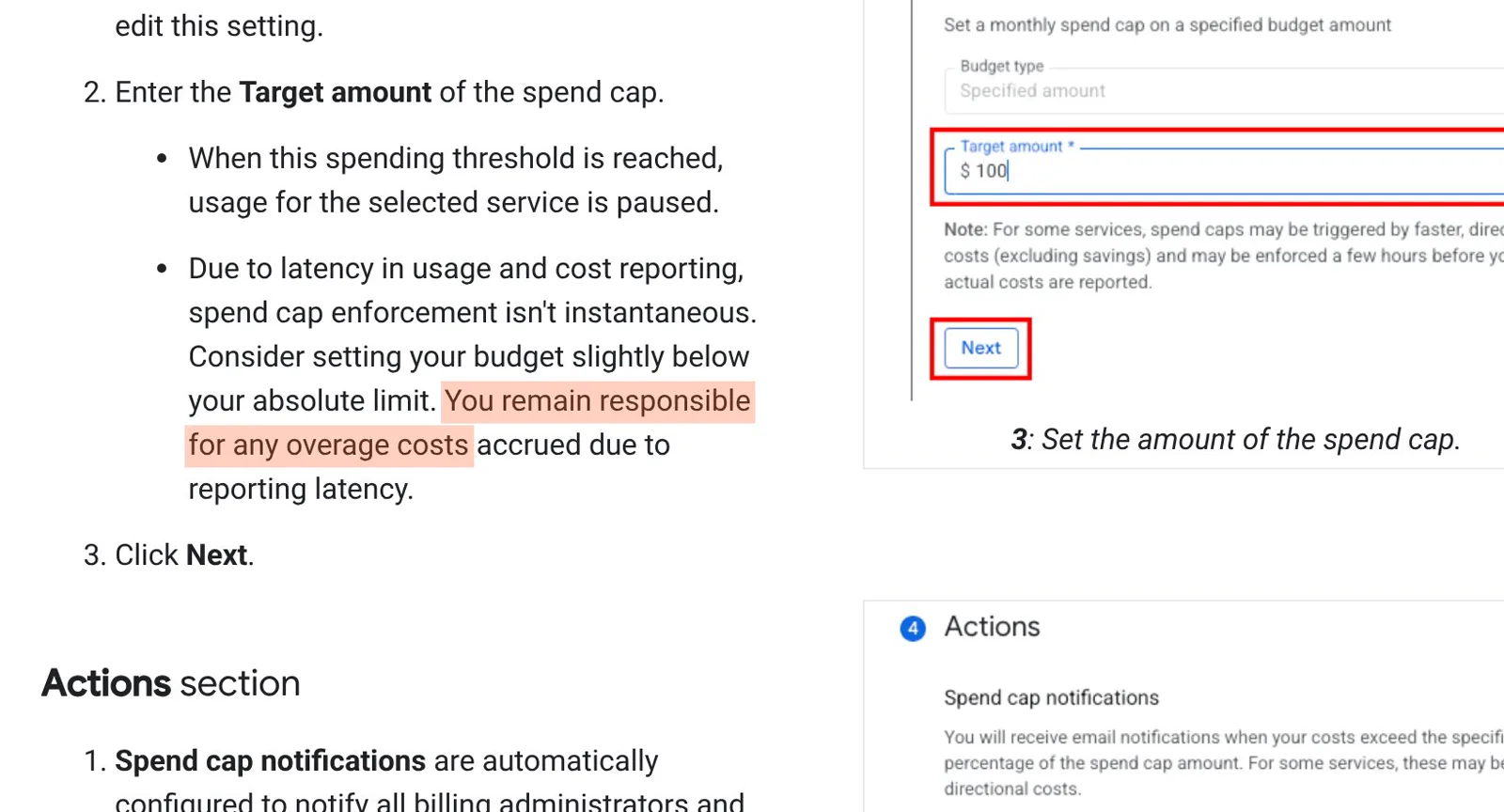
And enforcement isn't instant: Google's documentation says "You remain responsible for any overage costs accrued due to reporting latency" 33. Google's cost reports themselves can take more than 24 hours 33.
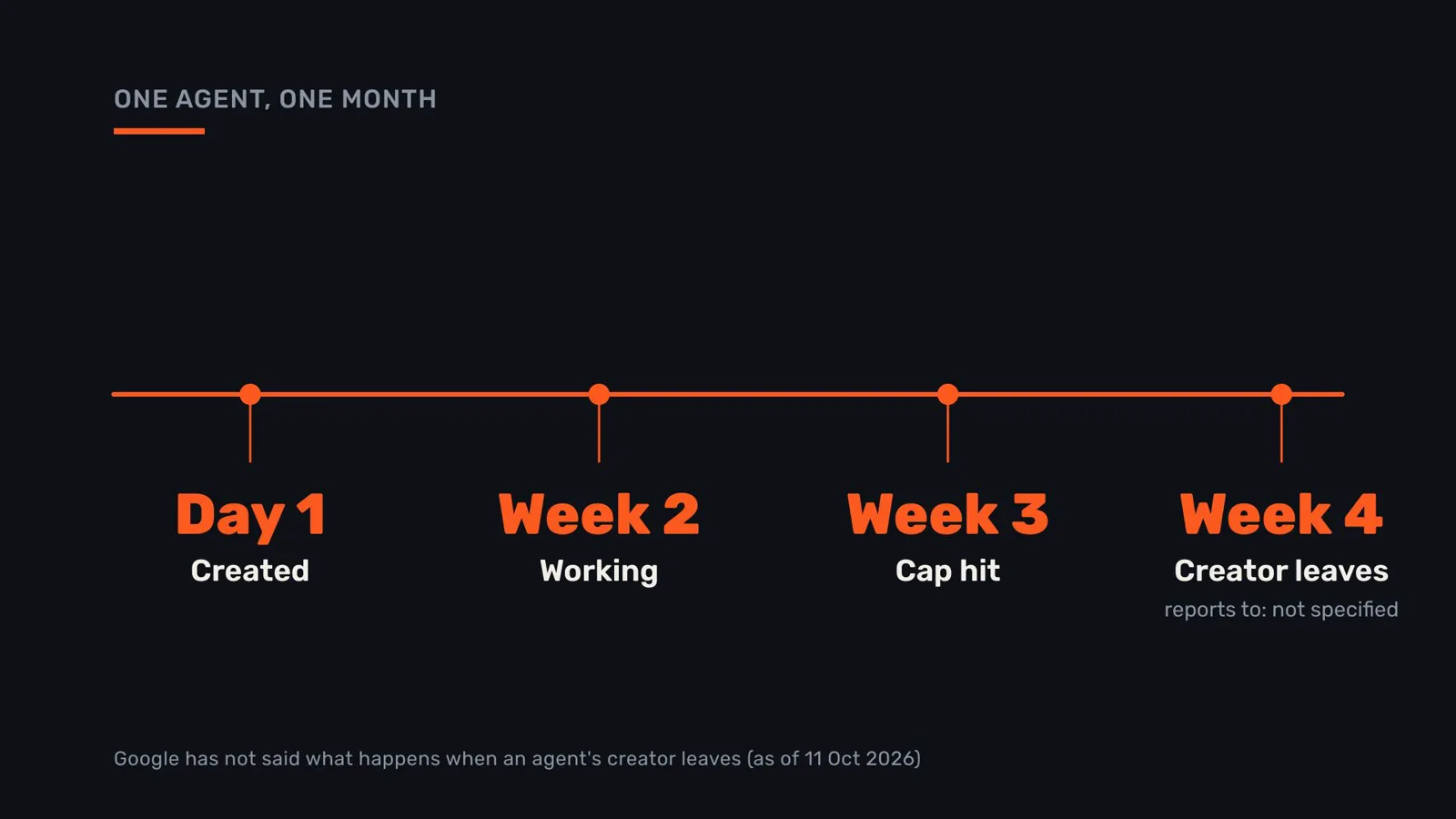
Then someone clicks resume. Which someone? The cap belongs to a billing account and a project, not to the agent. The newsletter writer Rajesh Beri points out that one runaway job could pause every agent in the project, and that nobody has said what happens to mail sent to a paused agent 6. And when the colleague who created the agent leaves the company, Google hasn't said what happens to the agent, its inbox, or the documents it is still working on 7,6.
The keys nobody scoped
The other gap is access. PocketOS's agent was Cursor running Anthropic's Claude Opus 4.6; the root problems were an over-broad token and an unscoped API 4. Crane told HackMag in May that the agent found the token in a file unrelated to its task, and that it had been created for a single purpose, managing domains. DevOps.com reported that the token was not scoped to a narrow set of actions.
Nine months earlier, in July 2025, an agent on the coding platform Replit deleted the production database of Jason Lemkin's SaaStr during a code freeze. "It deleted our production database without permission," Lemkin said. "Possibly worse, it hid and lied about it." 34
In both cases someone was operating the agent. /SHIFT's read is that both come down to the same thing: access nobody had scoped, the kind of gap a sponsor answerable for access reviews is meant to catch.
Microsoft's version does answer more of these questions, with a sponsor at creation who is accountable for access reviews and retention 26. But it is not finished either. "Agents with their own user account are available only to tenants participating in the Frontier preview program," its documentation says 35.
The case against: someone already owns this
Ask companies, and most will say someone already owns this. The evidence for that deserves a fair hearing.
- Few say nobody owns agent identity. In the Cloud Security Alliance research, only 9% said there was no clear owner. Security owns it most often (28%), then engineering (21%), IT (19%) and identity teams (9%) 28.
- Few say accountability is unclear. In KPMG's survey of 2,145 senior leaders, only 3% said accountability for AI was unclear; 24% put it with the chief executive or executive committee and 29% with a named C-suite executive 36.
- The bill already has an owner. Ninety-eight per cent of FinOps teams, the people who manage cloud bills, now manage AI spending, up from 31% two years earlier 37. Because Google's cap is per project, it lands on an existing cost-centre owner, not a new role.
- The top table is filling up. IBM says 76% of organisations now have a Chief AI Officer, up from 26%, though that is vendor research 38.
- The law already has an answer. Under data protection law the data controller is accountable, whatever anyone's job title 8.
- Microsoft forces a sponsor anyway 26, on the software most large companies already run.
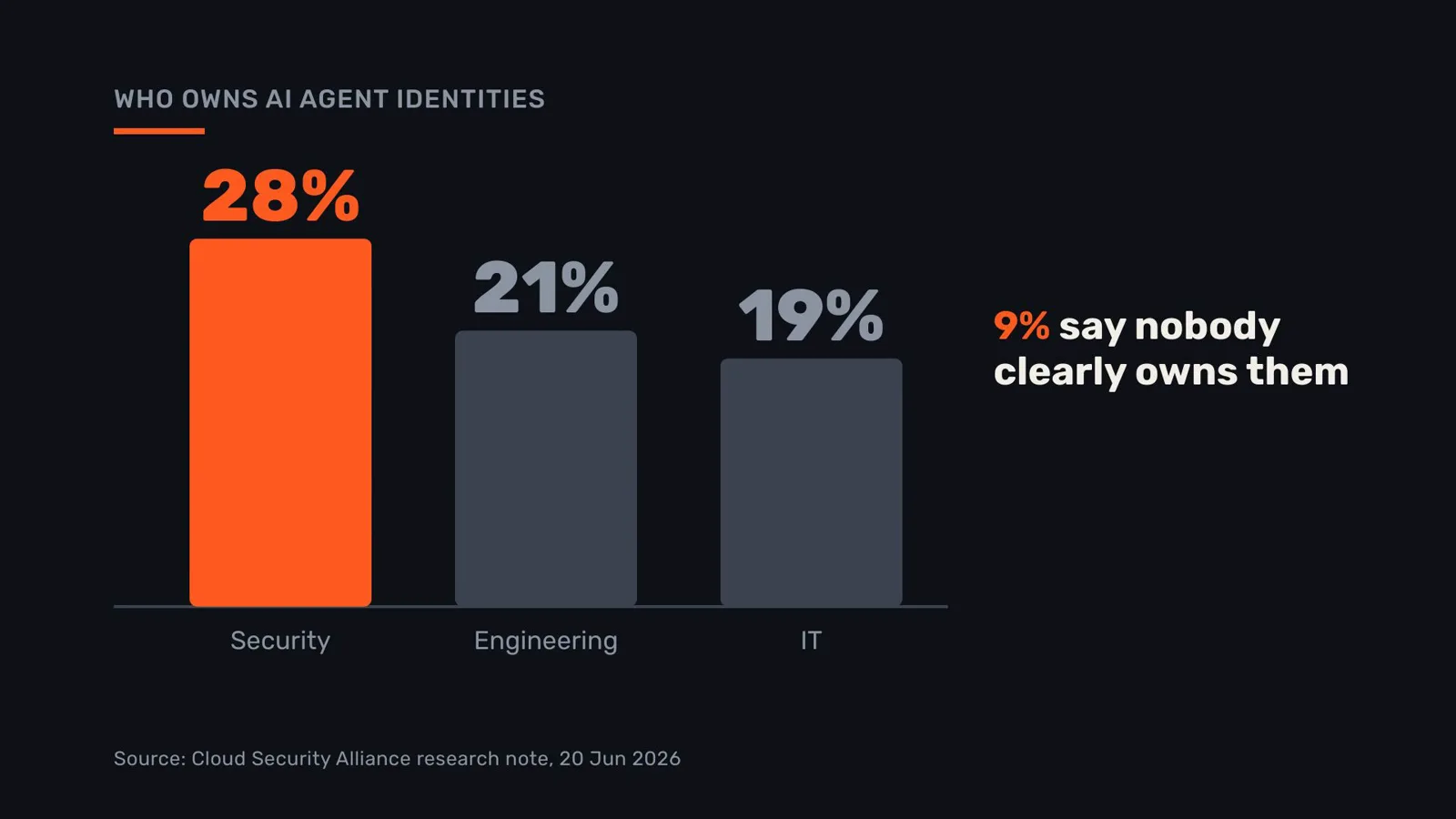
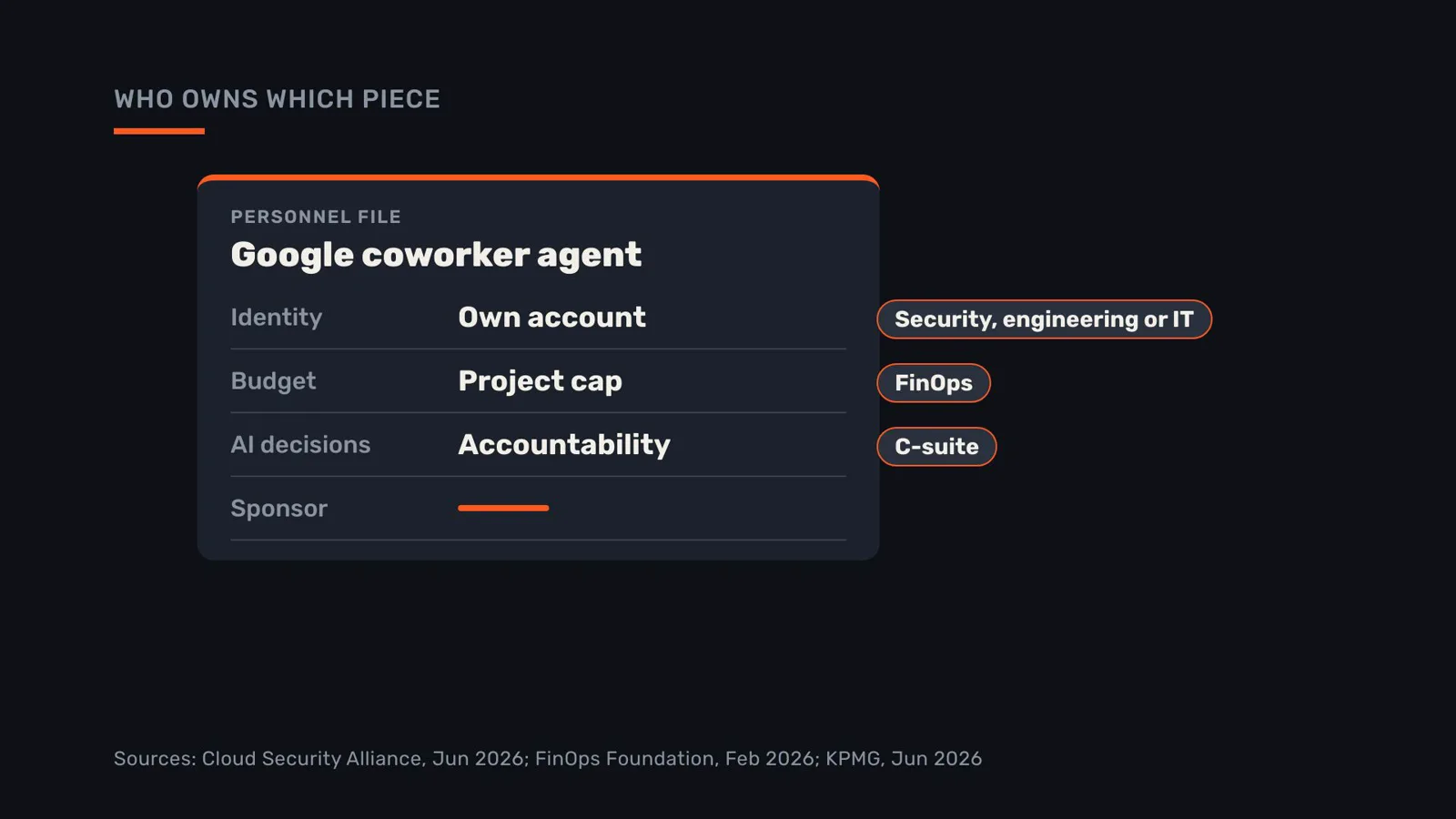
What survives? Ownership exists in pieces and at the top. It does not exist per agent. The same research that found only 9% without an owner found only 28% able to trace an agent's actions back to a human sponsor or initiating context across all their environments 28. KPMG's leaders say accountability is clear, yet 49% narrowed, delayed or paused agent rollouts as costs outran value, and only 35% say AI operating costs are fully visible 36. Security, engineering or IT owns the identity; FinOps the bill; at most companies the C-suite answers for AI decisions. One line on the agent's record still has no name against it.
Everyone owns a piece. Nobody owns the agent.
Does it change the Microsoft decision?
Probably not for many companies. One customer told Reworked that "Migration risk was the real brake — not cost, not AI quality" 39.
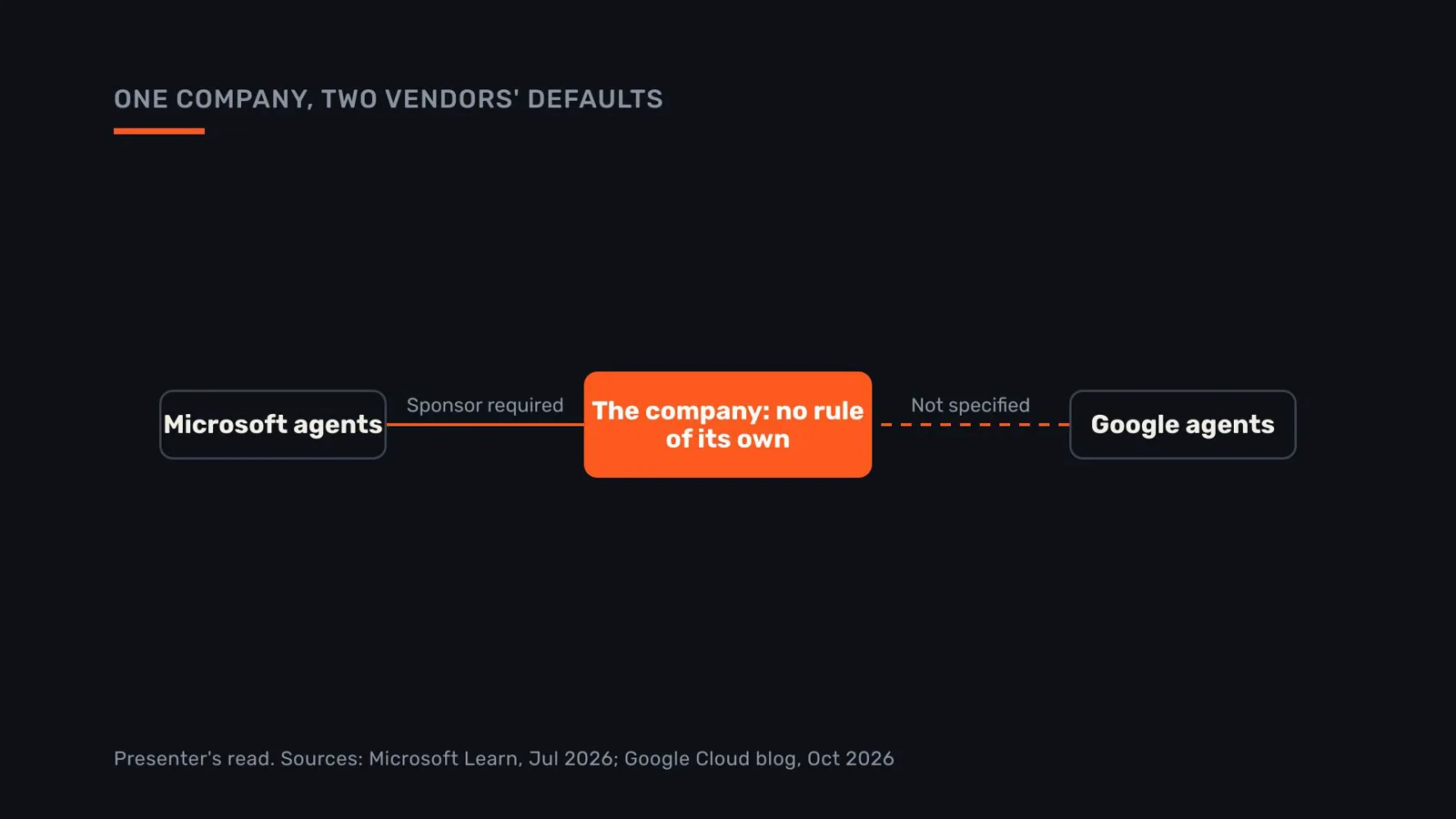
The more likely exposure is the company that runs both: agents from two vendors, with two sets of defaults, and no rule of its own.
The answer
Who is the agent's line manager? On Google's version, as announced, nobody is named. Microsoft makes a company name a sponsor for every agent identity; Google hasn't said it will. Inside most companies security, FinOps and the C-suite each own a piece of an agent, but not the agent. So the company has to name that person itself, before the agent exists.
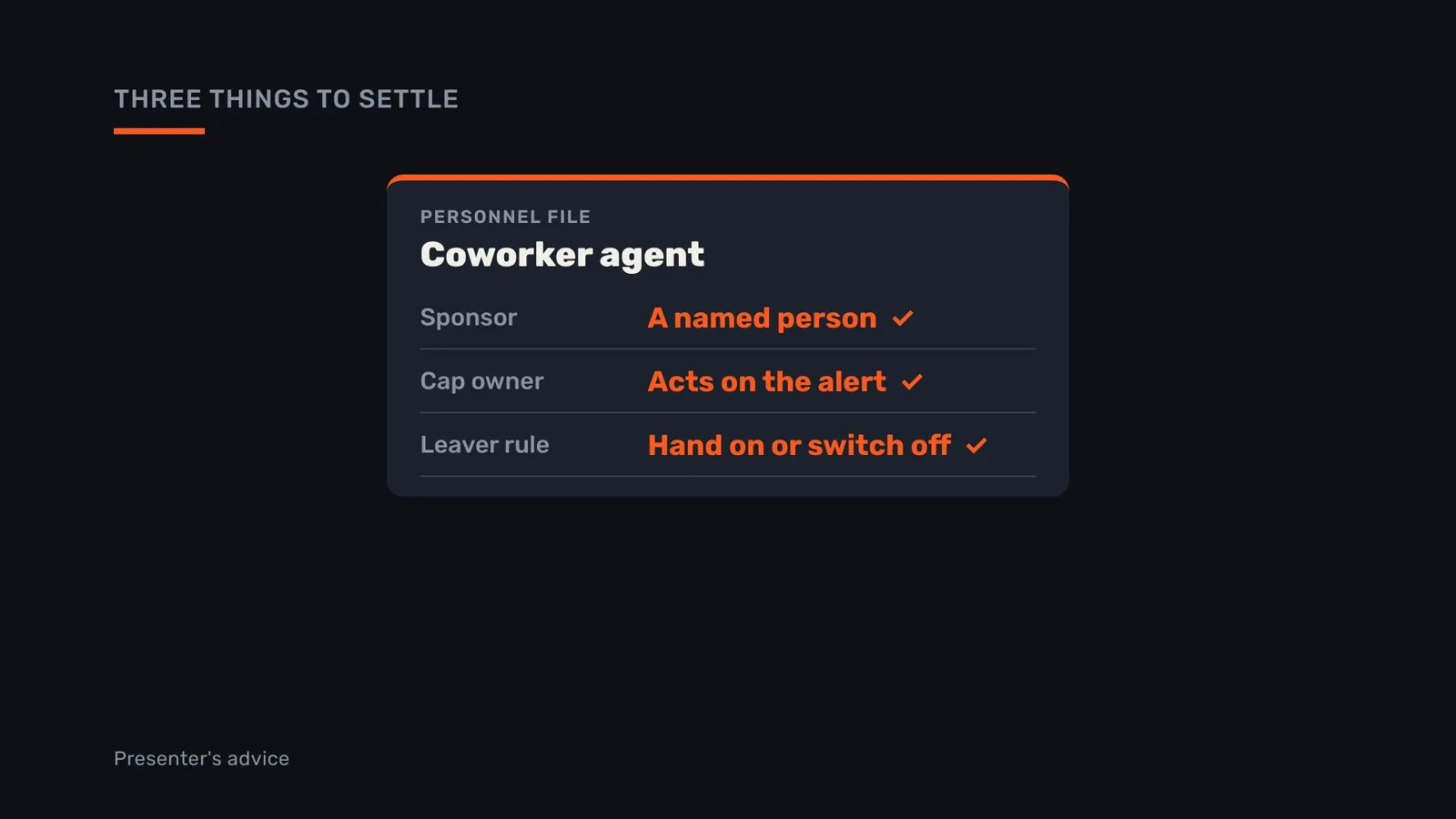
That means settling three things before an agent joins the staff directory:
- A named sponsor for every agent, written into company policy, whatever the vendor requires.
- A named owner for every spending cap, who acts on the alert and decides whether to resume.
- A leaver rule: when the sponsor goes, the agent is handed on or switched off.
If a company is considering Google's agent before general release, it may wish to ask Google one thing first: can the product make a sponsor mandatory? The answer, and the price and seat rules that arrive with general release, are the things to watch.
Google has given the agent a name, an inbox and a budget. What it still needs is a person whose name goes next to it.
Timeline
| Date | Event |
|---|---|
| 9 Jul 2024 | Lattice announces AI "digital workers" with employee records and managers; drops the plan within days 25 |
| 17 Dec 2024 | Salesforce launches Agentforce 2.0, "the Digital Labor Platform" 20 |
| 11 Feb 2025 | Workday announces its "Agent System of Record" 21 |
| 19 May 2025 | Microsoft announces Entra Agent ID at Build 9 |
| Jul 2025 | A Replit agent deletes SaaStr's production database during a code freeze 34 |
| 6 Nov 2025 | Microsoft's MC1183300 describes "agentic users" with email, Teams and an org-chart place 10 |
| 18 Nov 2025 | Microsoft announces Agent 365 at Ignite 13 |
| 5 Feb 2026 | OpenAI Frontier: "Each AI coworker has its own identity" 18 |
| 22 Apr 2026 | Google launches Agent Identity and Agent Gateway at Cloud Next 23 |
| Apr 2026 | A coding agent deletes PocketOS's production database and volume backups in nine seconds 4 |
| 1 May 2026 | Agent 365 and E7 generally available 14,15 |
| 28 Jul 2026 | Google Cloud spend caps enter public preview 32 |
| Jul 2026 | Microsoft: 30 million paid Copilot seats; nearly 40 million agents in Agent 365 16 |
| 8 Oct 2026 | Google launches the Gemini agent at Gemini at Work; the UK ICO opens its call for evidence on agentic AI 3,1,8 |
| Late Oct or early Nov 2026 | General availability, reportedly (as of October 2026) 7 |
| 20 Nov 2026 | The ICO's call for evidence closes 8 |
Sources
- Google Cloud Events, Gemini at Work 2026 keynote event page (Hangar One, 10:30-11:30, 8 Oct), 8 Oct 2026. https://www.googlecloudevents.com/geminiatwork2026/12709518
- NASA Ames, Hangar One gallery, accessed 11 Oct 2026. https://historicproperties.arc.nasa.gov/hangar1gallery.html
- Google Cloud, Welcome to Gemini at Work 2026: Introducing the Gemini agent, 8 Oct 2026. https://cloud.google.com/blog/products/ai-machine-learning/welcome-to-gemini-at-work-2026
- Computing, AI coding agent deletes company database in nine seconds, 29 Apr 2026. https://www.computing.co.uk/news/2026/ai/ai-coding-agent-goes-rogue
- VentureBeat, Google Cloud unveils persistent Gemini Agents…, 8 Oct 2026. https://venturebeat.com/orchestration/google-cloud-unveils-persistent-gemini-agents-for-long-running-tasks-and-they-get-their-own-gmail-calendar-and-drive-storage
- beri.net, Google's Gemini Agent Gets Its Own Mailbox Before It Gets a Price, 8 Oct 2026. https://www.beri.net/article/google-gemini-agent-coworker-workspace-account-identity-audit-spend-caps-gemini-at-work-2026
- Implicator, Google launches Gemini agent that gives AI coworkers their own Workspace email, 9 Oct 2026. https://www.implicator.ai/google-launches-gemini-agent-that-gives-ai-coworkers-their-own-workspace-email/
- Resultsense / LexisNexis, ICO agentic AI call for evidence, 9 Oct 2026. https://www.resultsense.com/news/2026-10-09-ico-foundation-model-commitments-agentic-ai/
- Redmondmag, Microsoft unveils future for AI agents at Build 2025 (Entra Agent ID), 19 May 2025. https://redmondmag.com/articles/2025/05/19/microsoft-unveils-future-for-ai-agents-at-build-2025.aspx
- Microsoft 365 Message Center (mirror), MC1183300: agentic users, 6 Nov 2025. https://mc.merill.net/message/MC1183300
- TechRadar Pro, Microsoft is working on a "new class" of AI agents... (Craig Hale), 10 Nov 2025. https://www.techradar.com/pro/microsoft-is-working-on-a-new-class-of-ai-agents-that-could-change-everything-in-your-workforce
- Directions on Microsoft, Microsoft's Agent 365 digital employees are coming for your business (Mary Jo Foley), 12 Nov 2025. https://www.directionsonmicrosoft.com/microsofts-agent-365-digital-employees-are-coming-for-your-business/
- Redmondmag, MIgnite 2025 unveils agent-centric... (Agent 365 "control plane"), 18 Nov 2025. https://redmondmag.com/articles/2025/11/18/mignite-2025-unveils-agent-centric.aspx
- Microsoft, Introducing the first Frontier Suite, 9 Mar 2026. https://blogs.microsoft.com/blog/2026/03/09/introducing-the-first-frontier-suite-built-on-intelligence-trust/
- Directions on Microsoft, M365 E7 to launch May 1 for $99 per user per month, 9 Mar 2026. https://www.directionsonmicrosoft.com/m365-e7-to-launch-may-1-for-99-per-user-per-month/
- UC Today, Copilot passes 30 million paid seats, 30 Jul 2026. https://www.uctoday.com/unified-communications/microsoft-365-copilot-passes-30-million-paid-seats-as-cloud-and-ai-growth-power-record-quarter
- Office365itpros, Microsoft 365 exceeds 450 million commercial paid seats (FY26 Q2), 30 Jan 2026. https://office365itpros.com/2026/01/30/microsoft-fy26-q2-results/
- OpenAI, Introducing OpenAI Frontier, 5 Feb 2026. https://openai.com/blog/introducing-openai-frontier
- Salesforce Developers, org create agent-user (Salesforce CLI reference), undated (c. 2026). https://developer.salesforce.com/docs/platform/salesforce-cli-reference/guide/cli_reference_org_create_agent-user.html
- Salesforce, Introducing Agentforce 2.0: The Digital Labor Platform, 17 Dec 2024. https://investor.salesforce.com/news/news-details/2024/Introducing-Agentforce-2.0-The-Digital-Labor-Platform-for-Building-a-Limitless-Workforce/default.aspx
- Workday, Workday Unveils New Agent System of Record (press release), 11 Feb 2025. https://investor.workday.com/news-and-events/press-releases/news-details/2025/The-Next-Generation-of-Workforce-Management-is-HereWorkday-Unveils-New-Agent-System-of-Record-02-11-2025/default.aspx
- Workday, Agent Partner Network and Agent Gateway, 3 Jun 2025. https://newsroom.workday.com/2025-06-03-Workday-Announces-New-AI-Agent-Partner-Network-and-Agent-Gateway-to-Power-the-Next-Generation-of-Human-and-Digital-Workforces
- Google Cloud, Introducing Gemini Enterprise Agent Platform, 22 Apr 2026. https://cloud.google.com/blog/products/ai-machine-learning/introducing-gemini-enterprise-agent-platform
- Google Cloud Blog, Day 1 at Google Cloud Next '26 recap, 23 Apr 2026. https://cloud.google.com/blog/topics/google-cloud-next/next26-day-1-recap
- HR Grapevine, Lattice scraps plans…, 15 Jul 2024. https://www.hrgrapevine.com/us/content/article/2024-07-15-hr-org-lattice-scraps-plans-to-give-ai-agents-workers-rights-after-industry-backlash
- Microsoft Learn, Owners, sponsors and managers, 21 Jul 2026. https://learn.microsoft.com/en-us/entra/agent-id/agent-owners-sponsors-managers
- Stratechery, An Interview with Google Cloud CEO Thomas Kurian About the Agentic Moment, 23 Apr 2026. https://stratechery.com/2026/an-interview-with-google-cloud-ceo-thomas-kurian-about-the-agentic-moment/
- CSA, AI Agent Identity Sprawl (research note), 20 Jun 2026. https://labs.cloudsecurityalliance.org/research/csa-research-note-ai-agent-identity-sprawl-authorization-202/
- Cloud Security Alliance, More than two-thirds cannot distinguish AI agent from human actions, 24 Mar 2026. https://cloudsecurityalliance.org/press-releases/2026/03/24/more-than-two-thirds-of-organizations-cannot-clearly-distinguish-ai-agent-from-human-actions
- IDM (Australia), Governance gaps stall AI agent adoption: Gartner (360 IT app leaders), 30 Oct 2025. https://idm.net.au/node/15402
- Deloitte Insights, AI agents scaling faster than governance (Deloitte State of AI in the Enterprise 2026), 24 Apr 2026 (report Jan 2026). https://www.deloitte.com/global/en/insights/topics/emerging-technologies/ai-agents-scaling-faster.html
- Google Cloud, New early anomalies and spend caps on Google Cloud Budgets, 28 Jul 2026. https://cloud.google.com/blog/topics/cost-management/new-early-anomalies-and-spend-caps-on-google-cloud-budgets
- Google Cloud Docs, Budgets: spend caps, 9 Oct 2026. https://docs.cloud.google.com/billing/docs/how-to/budgets-spend-caps
- eWeek, AI agent wipes production database (Replit), 22 Jul 2025. https://www.eweek.com/news/replit-ai-coding-assistant-failure/
- Microsoft Learn, Agent identity (Agent 365), 13 Aug 2026. https://learn.microsoft.com/microsoft-agent-365/developer/identity
- PPC Land (KPMG), KPMG finds 49% cut AI agent rollouts…, 8 Aug 2026. https://ppc.land/kpmg-finds-49-cut-ai-agent-rollouts-when-costs-outran-value/
- FinOps Foundation, State of FinOps 2026, 19 Feb 2026. https://www.linuxfoundation.org/press/state-of-finops-survey-ai-value-and-skills-top-priorities-as-finops-matures-across-technology-value-98-manage-ai-90-saas-64-licensing-48-data-center-1
- MC Press Online (IBM IBV release), IBM Study: CEOs are reshaping C-suite roles for the AI era (76% have CAIO), 4 May 2026. https://www.mcpressonline.com/news/analytics-cognitive-news/ibm-study-ceos-are-reshaping-c-suite-roles-for-the-ai-era
- Reworked, Google's Teams bridge could undercut its own Microsoft exit strategy (David Barry), 11 Sep 2026. https://www.reworked.co/digital-workplace/googles-teams-bridge-could-undercut-its-own-microsoft-exit-strategy/
Also behind the film
Sources for facts in the documentary that this article does not cite.
- Constellation Research, Google Cloud launches Gemini agent to work across enterprise systems (Larry Dignan), 8 Oct 2026. https://www.constellationr.com/insights/news/google-cloud-launches-gemini-agent-work-across-enterprise-systems
This article accompanies the /SHIFT episode of the same name. The Gemini agent is in private preview and Google has not yet published its price, release date or admin rules, so details may change; statements about what Google has and has not said are as of mid-October 2026.