AI Isn't Taking Jobs. It's Taking the First One
In 2026 AI became the reason American companies most often give for cutting jobs, yet economists cannot find the lost jobs. They are looking for firings; the clearest trace is in hiring, at the bottom of the ladder.

In brief
- Companies cited AI for 120,136 announced US job cuts in January to September 2026, about 21%, the leading stated reason this year. Yet Stanford and Yale find no sign of widespread job losses.
- The layoff count records what companies choose to say, and some of the biggest "AI layoffs" are visibly about something else.
- Employment of 22-to-25-year-olds in the most AI-exposed jobs is 19% below where it would be had it kept pace with less-exposed peers of the same age, Stanford finds, with no comparable gap for experienced workers. It runs through fewer hires, not more firings.
- Firms are writing it into hiring rules, and Klarna more than halved its staff largely by not replacing leavers.
- The cause is contested: two economists argue remote work explains much of the junior slump. Stanford says its gap survives that test.
- Verdict: prepare. AI is closing the way in to written-down, process-heavy work, over years rather than quarters. For anyone starting out in that kind of work, act now.
A table with AI at the top
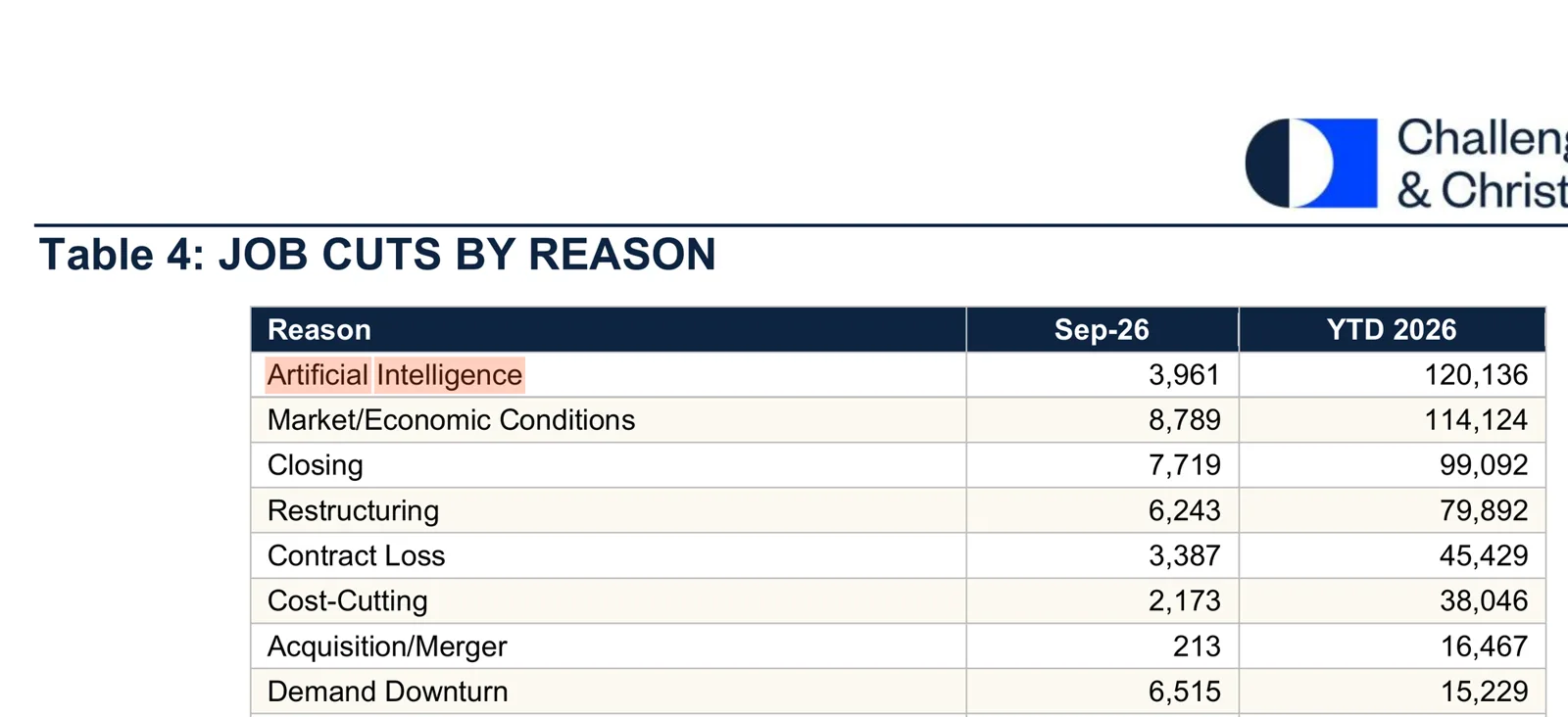
On 1 October 2026 the outplacement firm Challenger, Gray & Christmas published its monthly count of announced US job cuts. Table 4 sorts them by the reason employers gave. At the top of the year-to-date column sat "Artificial Intelligence": 120,136 cuts out of 573,195, about 21%, ahead of market and economic conditions at 114,124 1.
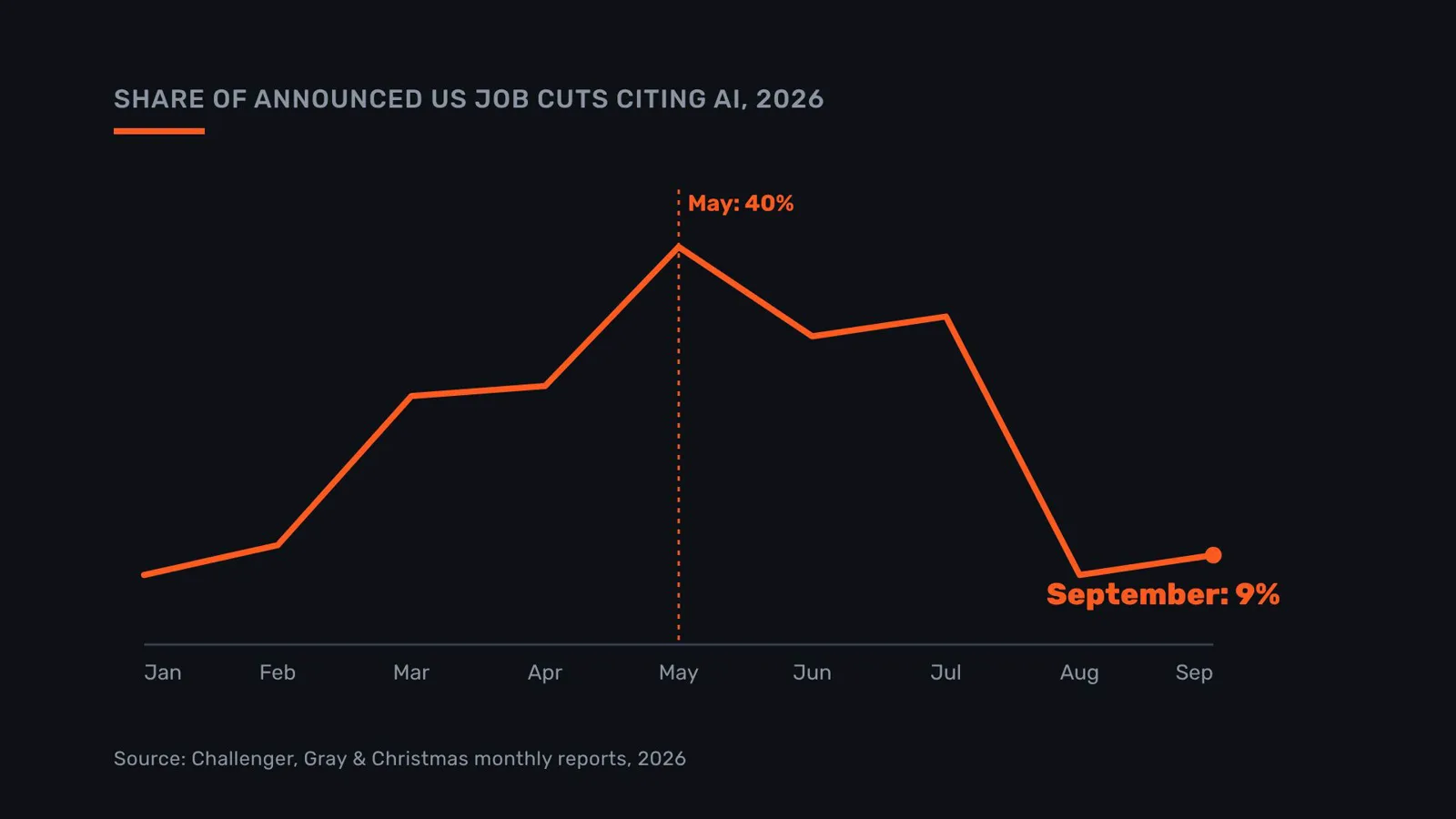
In all of 2025, companies cited AI for 54,836 cuts, about 5% of the year's total 2,3. In March 2026 it became the top stated reason for the first time 4, and in May it peaked: 38,579 cuts, 40% of the month and the highest monthly figure since Challenger began tracking the reason in 2023 5. "AI is now the leading reason companies give for cutting jobs," Andy Challenger said that June 5.
But by September AI had slipped to fifth among the month's reasons, at 3,961 cuts, about 9%, though it remains first for the year 1. And total announced cuts were down 39% on the same nine months of 2025 1,6. The AI label grew while the pile it labels shrank.
So if AI is now the number one reason companies give for cutting jobs, why can't the jobs data find the jobs?
What the wider data says
Stanford's Digital Economy Lab, working with payroll records from ADP, put it bluntly in August: "We find no evidence of widespread, economy-wide job displacement" 7,8. Yale's Budget Lab said in September that the data "does not provide clear evidence of labor market disruption associated with AI" 9. In February, its executive director, Martha Gimbel, told Fortune that "it's not helpful to declare that it's here before it's here" 10.
The Chicago Fed found that employment in the occupations where AI is most applicable grew by 4.05% between 2019 and 2024, while the least applicable remained slightly below their 2019 level 11. Its limits: no age split, and data that end in 2024 11. Executives agree. In a survey for the National Bureau of Economic Research, nine in ten of about 6,000 executives in the US, UK, Germany and Australia reported no effect of AI on employment at their firm over three years; they expect a fall of about 0.7% over the next three 12.
What AI can do is not what it has done
None of this means AI is weak. MIT FutureTech, drawing on thousands of worker evaluations of real tasks, found that models "can do a minimally-sufficient job without human edits on roughly half to three-quarters of text-based tasks presented to them" 13. The failure rate halves every 2.2 to 2.8 years; on current trends, that means 88–97% success by 2030 13. But the authors draw the line themselves: "our results document AI capabilities rather than actual AI adoption" 13.
The same distinction undoes one of the most quoted figures of the past year. MIT and Oak Ridge National Laboratory's Iceberg Index estimates that AI can technically perform skills worth 11.7% of US wage value, about $1.2 trillion; headlines turned that into AI replacing 11.7% of workers 14. Only 2.2%, about $211 billion, shows up in visible adoption, concentrated in the tech sector, and the authors write: "The Index does not predict job losses, adoption timelines, or net employment effects" 14. Exposed is not the same as gone.
Who is counting, and why the label pays
Then why do so many layoffs say AI? Because of who is counting. Challenger records the reason a company gives in its own announcement; where AI is only implied, it files the cut under "Technological Update (possibly AI)" instead 15. The count is a record of corporate messaging, and the firm is frank about the incentive. "Naming AI in a layoff announcement can win over investors while pushing current and prospective employees away," Andy Challenger said in August 15.
Oxford Economics shares the suspicion: "We suspect some firms are trying to dress up layoffs as a good news story rather than bad news" 16,17.
Three labels, three stories
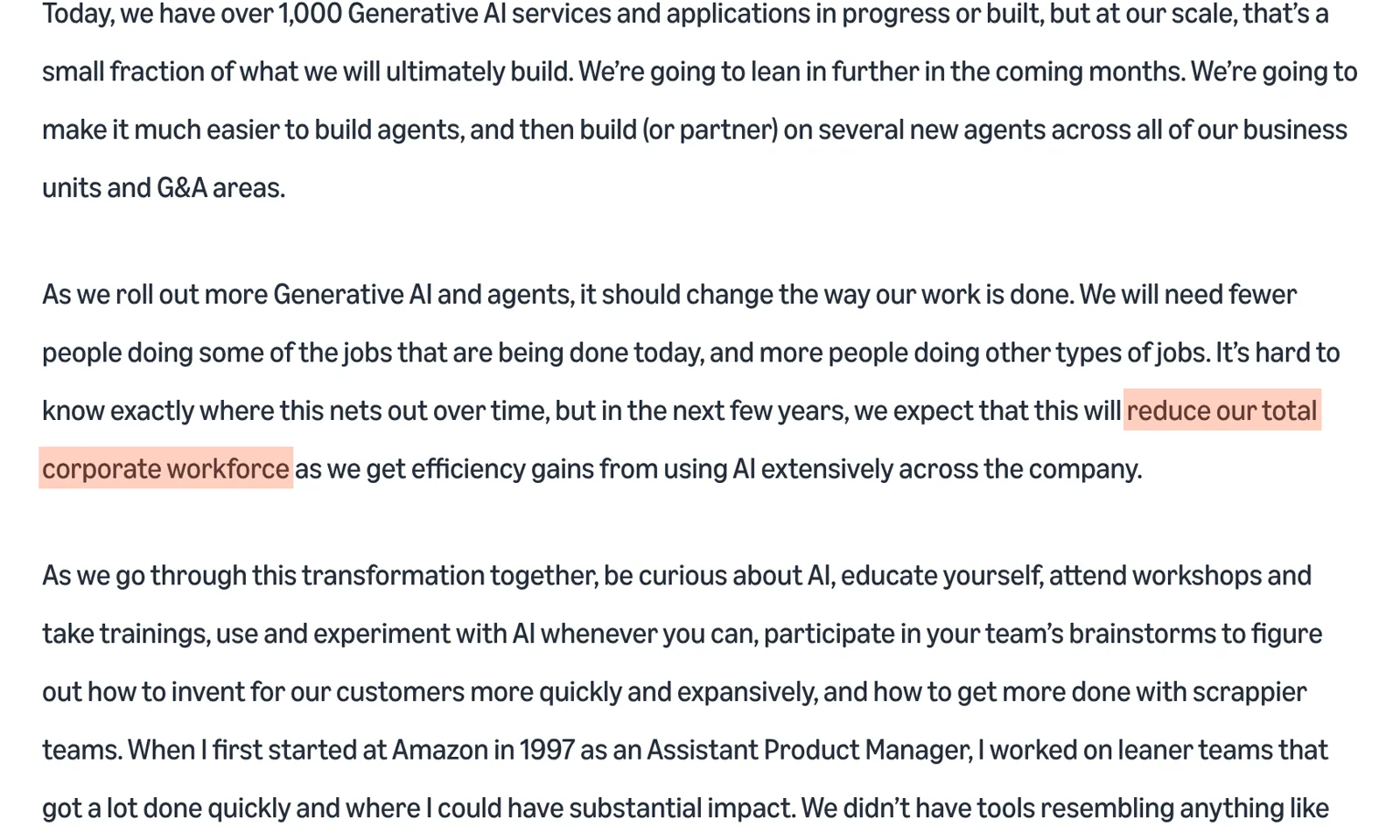
Amazon. In June 2025 Andy Jassy told staff: "we expect that this will reduce our total corporate workforce as we get efficiency gains from using AI extensively across the company" 18. In October Amazon cut about 14,000 corporate jobs, and Jassy told analysts: "it's not even really AI-driven, not right now at least. It really — it's culture" 19. Sixteen thousand more went in January 2026, framed as "reducing layers, increasing ownership, and removing bureaucracy" 20.
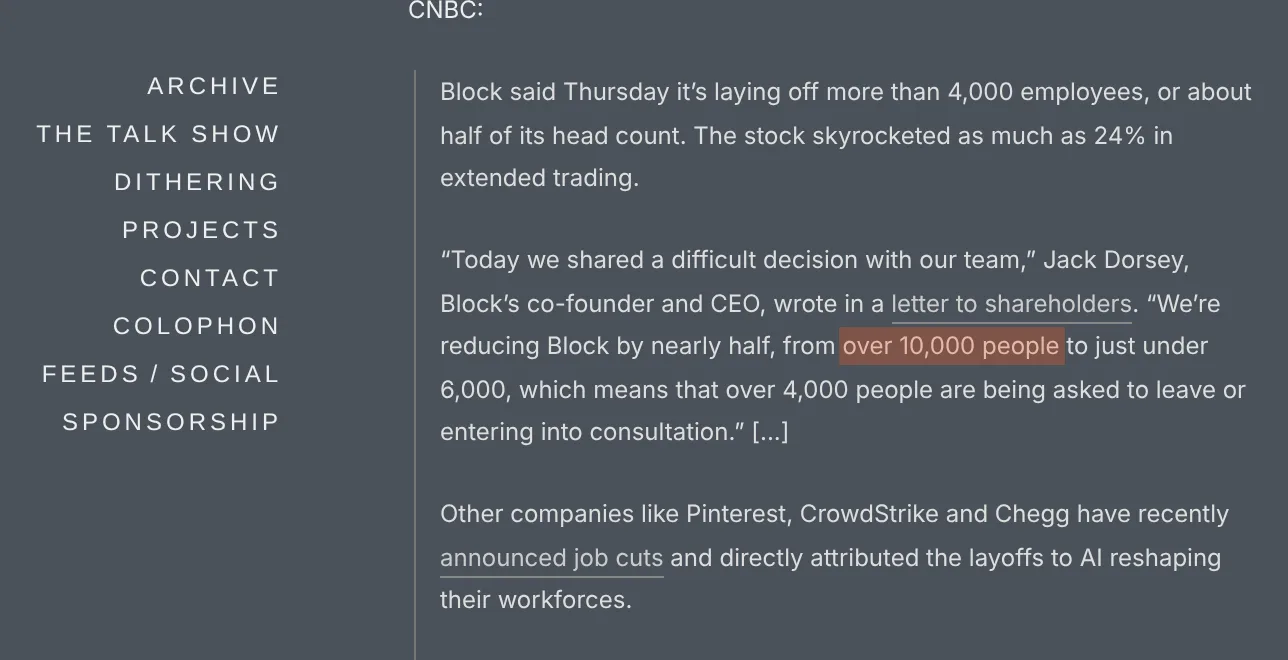
Block. On 26 February 2026 Jack Dorsey cut "over 4,000" people at the company behind Square and Cash App, taking it "from over 10,000 people to just under 6,000", and pointed to AI tools. In the same lower-case post he wrote: "we're not making this decision because we're in trouble. our business is strong" 21. The shares reportedly rose about 22% 22. By 3 March some of those laid off had been asked back; one said on LinkedIn he had been told his layoff was a "clerical error", which Block did not confirm 23. Bloomberg Law reported suspicions of AI-washing 24.
Meta. In April 2026 Meta cut about 8,000 jobs, 10% of its staff, and closed about 6,000 open roles, while guiding its capital spending, on data centres and AI infrastructure, to at least $115 billion for 2026, up from $72.2 billion in 2025 25. In that sense, AI arguably did cost those jobs: not by doing the work, but by taking the budget.
Some of it is real. Marc Benioff says of Salesforce's support staff: "I've reduced it from 9,000 heads to about 5,000, because I need less heads" 26. Even there, it is unclear how many were laid off rather than redeployed 26,27. Some cuts are real and plenty are relabelled, but neither leaves the trace that mass AI firing would.
Where it does show up
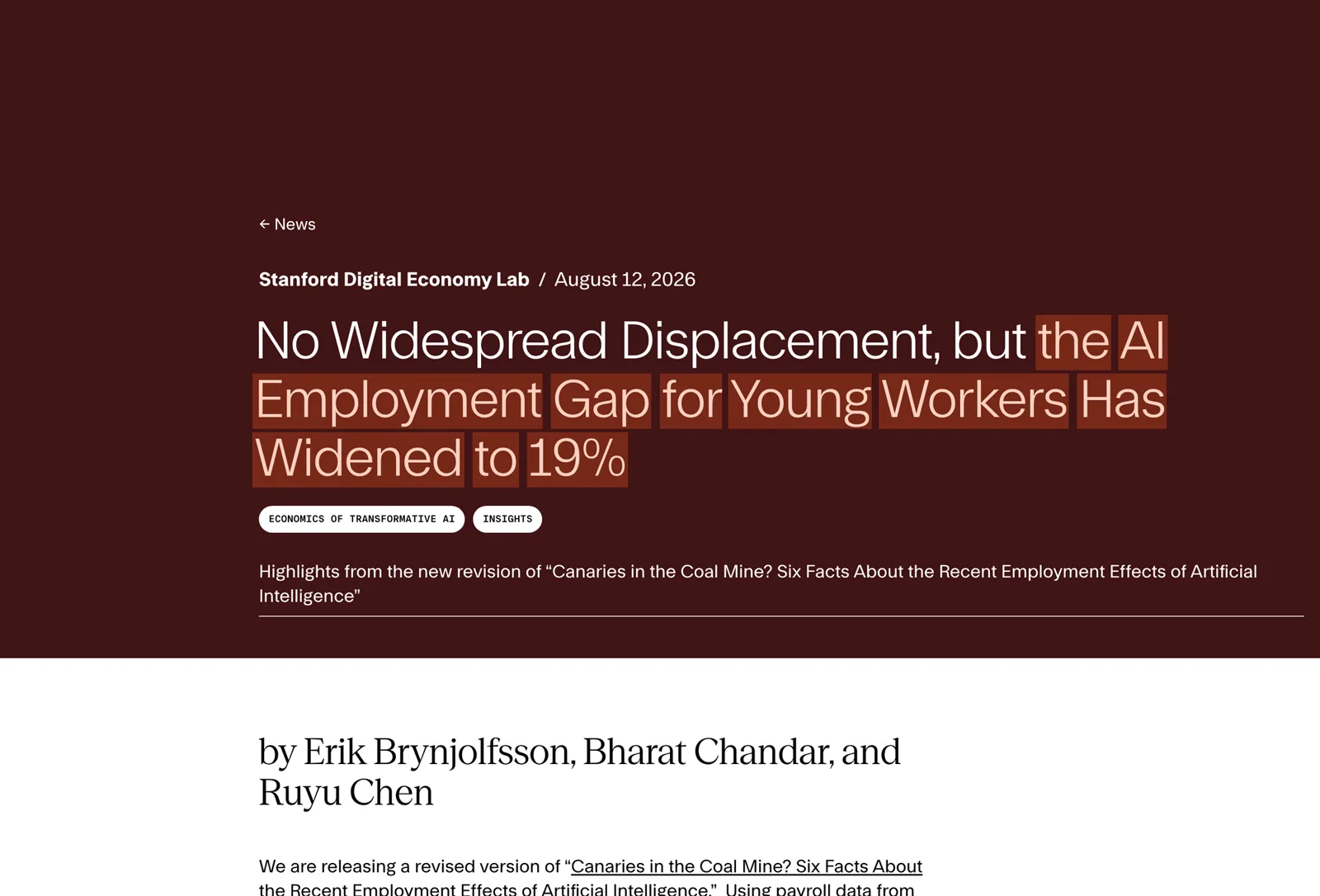
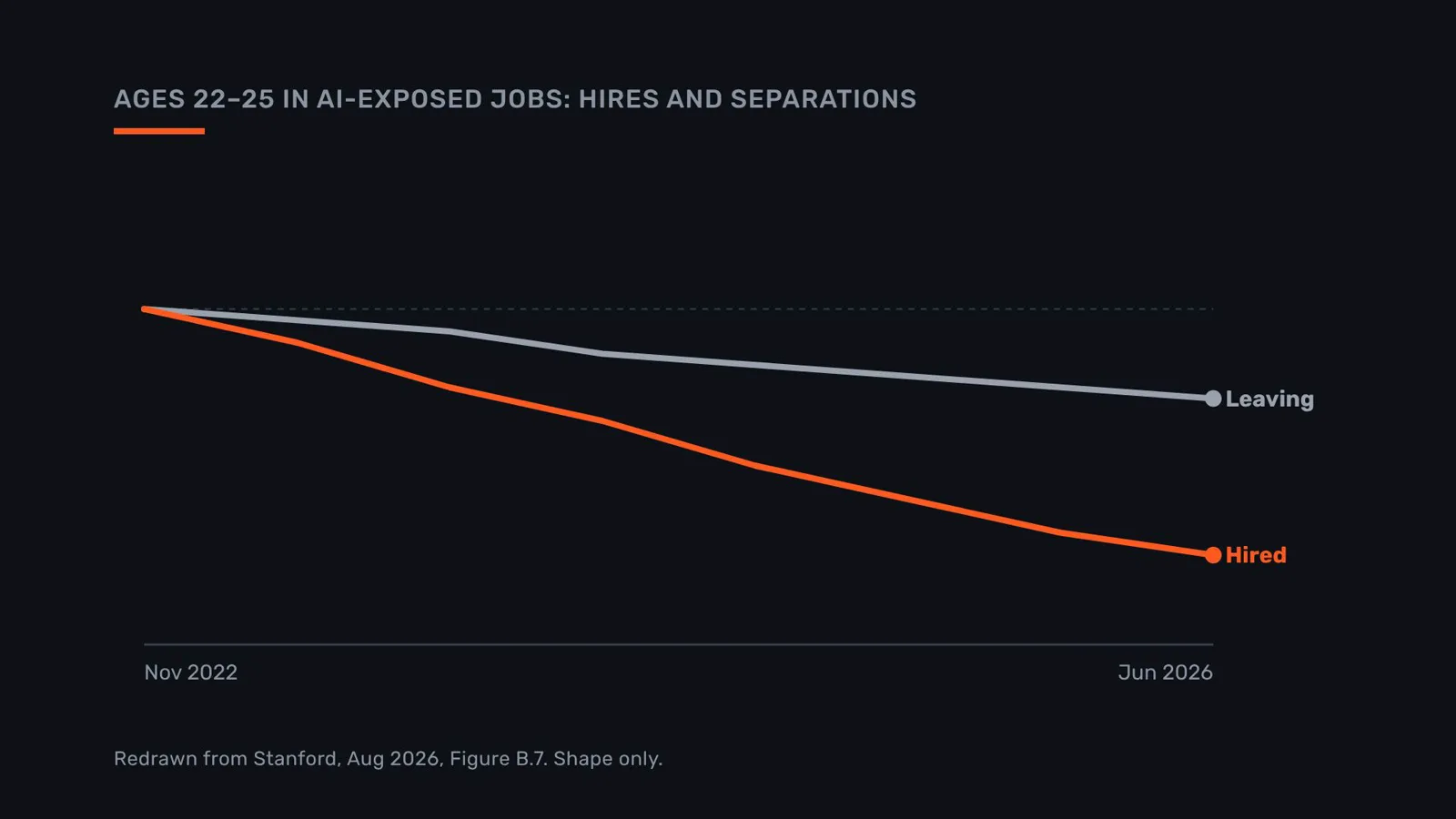
Stanford's headline had a second half. Split the payroll data by age and a gap opens. Among 22-to-25-year-olds in the jobs most exposed to AI, employment stands 19% below where it would be had it kept pace with that of their less-exposed peers; "experienced workers show no comparable gap" 7,8. In plain numbers, from November 2022 to June 2026, young workers' employment in the two most exposed fifths of jobs fell about 11%, while in the three least exposed it rose about 10% 7. A year earlier the gap was 15% 7.
For marketing and sales managers, Stanford's line for the youngest falls while the older lines rise; software developers and customer service show the same split 7. Same job title, opposite futures.
How it happens matters as much. The effect "operates primarily through reduced hiring of young workers rather than increased separations", the paper finds 7. And a US Census Bureau working paper, using official data independent of ADP, finds early-career employment in the most AI-exposed industries fell 12% over the ten quarters after ChatGPT, with the decline in hires the primary cause 28. Firing didn't go up. Hiring went down.
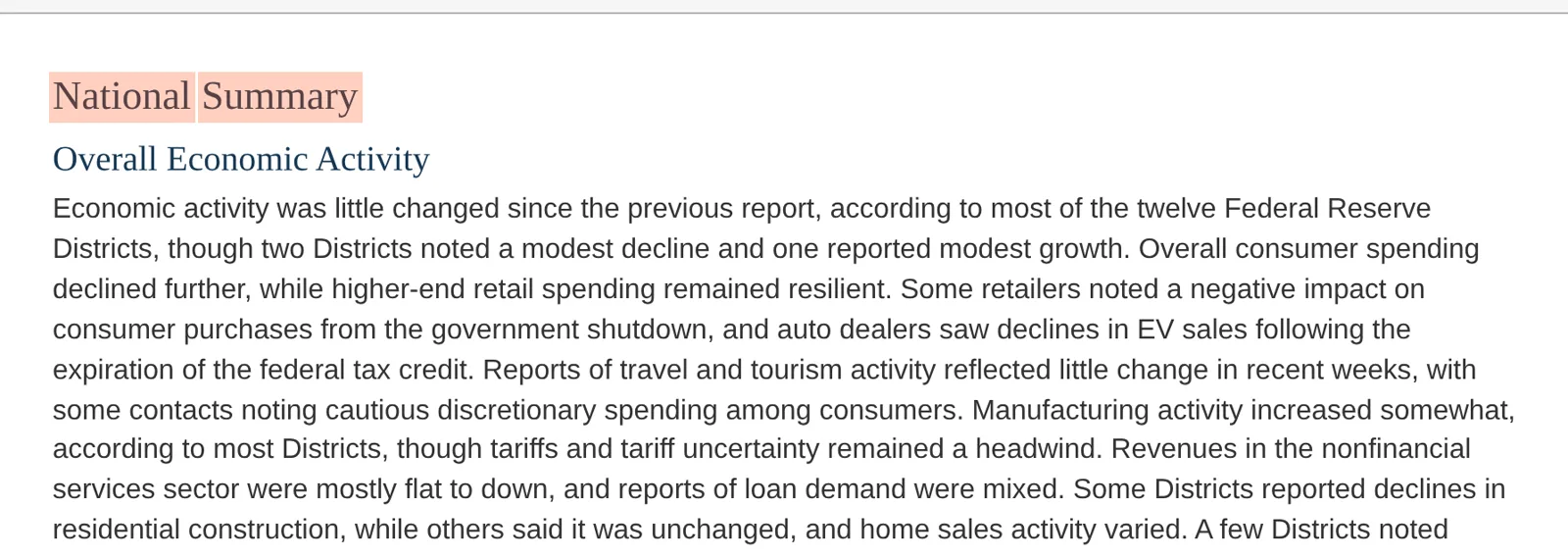
Businesses have said so. The Federal Reserve's Beige Book for November 2025, its roundup of reports from business contacts, recorded: "A few firms noted that artificial intelligence replaced entry-level positions or made existing workers productive enough to curb new hiring" 30. In February 2026 the Fed governor Michael Barr said AI "may be starting to adversely affect some groups, in particular young people who are just starting their careers in some sectors" 31.
That is what the layoff count misses. Our reading: AI isn't mainly taking jobs. It is taking the first one.
The hiring gate
Who does the juniors' work, then? Part of the answer is written into hiring rules. In April 2025 Shopify's Tobi Lütke told his teams: "Before asking for more headcount and resources, teams must demonstrate why they cannot get what they want done using AI" 32. Duolingo's Luis von Ahn wrote that "headcount will only be given if a team cannot automate more of their work"; the company says it has never laid off a full-time employee 33,34. None of these is a layoff, so none appears in a layoff count.
Stanford's authors suggest why it falls on the young: "AI may be automating the checkable, process-intensive tasks that historically justified entry-level headcount, while increasing the leverage of experienced staff" 7. If they are right, the work goes to the machine and to the people already there.
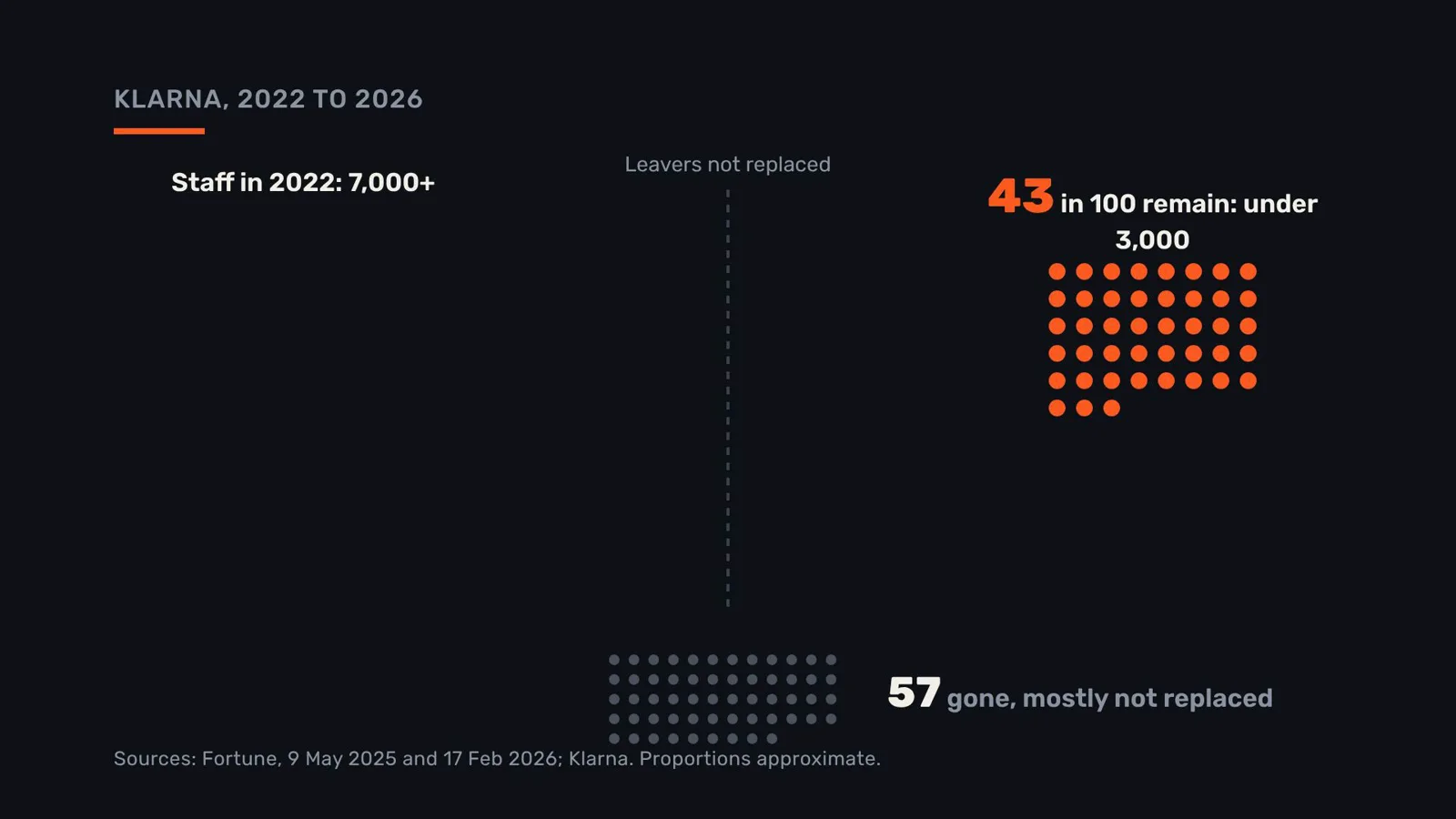
Klarna, the Swedish buy-now-pay-later firm, shows how. After a 2022 layoff, it froze hiring from late 2023 for almost everything except engineers and stopped replacing leavers, with attrition at about 20% a year 35,36,37. Its AI assistant, it said in February 2024, did "the equivalent work of 700 full-time agents" 38. Headcount went from more than 7,000 in 2022 to fewer than 3,000 by early 2026 35,36,37. Then, in May 2025, Sebastian Siemiatkowski told Bloomberg: "what you end up having is lower quality". Klarna began hiring human support agents again, but kept the smaller company 35,39,37.
IBM chose differently. Arvind Krishna told the Wall Street Journal that AI agents had taken over the work of a couple of hundred HR staff (the Journal's paraphrase), which "gives you more investment to put into other areas"; IBM hired programmers and salespeople, and "our total employment has actually gone up" 40,41. Same technology: fewer people, or different people.
Britain shows the same shape
In a Work Foundation survey of 1,001 UK business leaders, 36% said they had cut entry-level jobs in the past year and 43% that they had invested in AI or automation that reduced entry-level roles, 60% among large employers 42,43. Graduate adverts on the job site Adzuna reportedly fell to 8,383 in July 2026, down 45.6% from 15,397 in July 2025 and the lowest since 2016, though recruitment bodies caution that adverts are not the same as jobs 44,45,46,47.
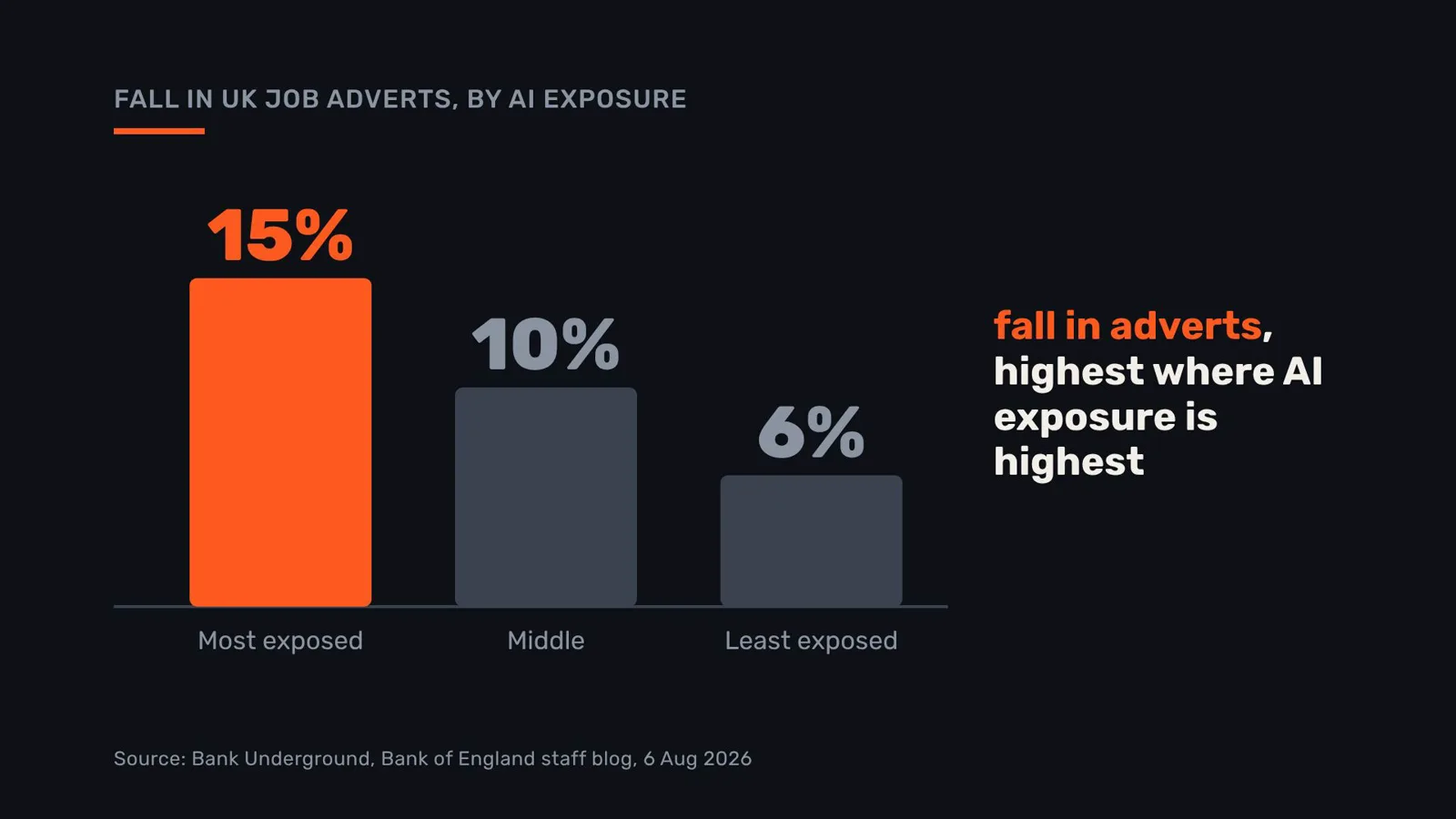
Bank of England staff found UK job adverts fell 15% in the most AI-exposed occupations, 10% in the middle and 6% in the least exposed; customer service fell 23% and admin 22% 48. The author still judged "confident attribution remains premature" 48. In December 2025 the Governor, Andrew Bailey, asked: "We do have to think about, what is it doing to the pipeline of people? Is it changing it or not?" 49
Two questions for any role
First, is the work codified, "formal, standardized, documented knowledge that can be taught through education, textbooks, or written procedures", or tacit, "acquired through practice, mentorship, and repeated exposure to real situations"? 8 Second, does AI do the work, or help someone do it?
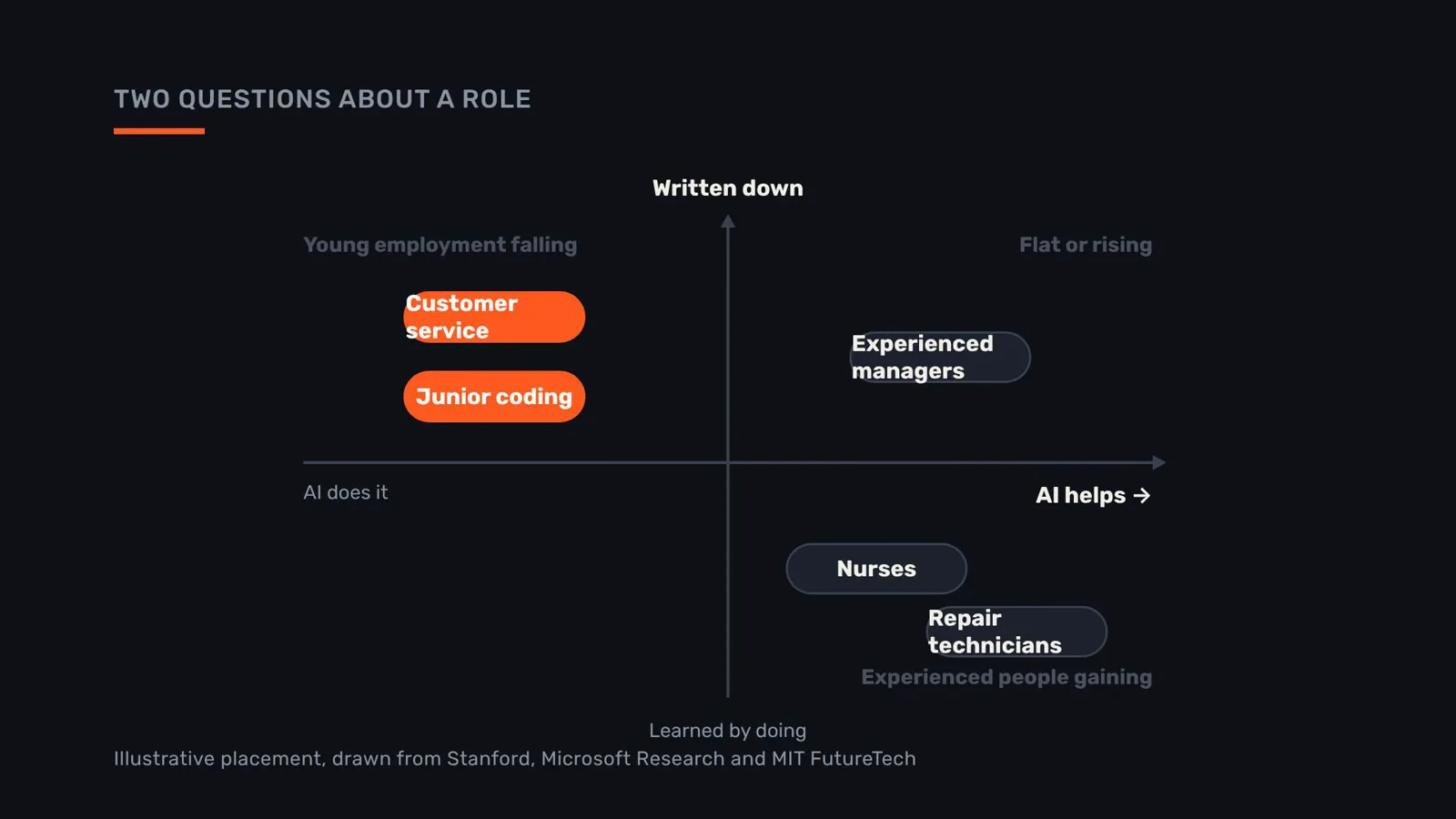
Declines are concentrated where AI substitutes for human tasks; where it complements workers, employment is flat or rising, especially for experienced workers 7. Stanford's suggestive finding: young workers lose ground in codified work, while experienced workers in tacit work gain 7.
Here is the catch. The tacit know-how that protects experienced staff is picked up by doing the job, and in the most exposed jobs fewer young people are getting in to do it 8,7. Cut the first rung, and in a few years who is ready for the second?
The case against
All of this assumes AI is the cause. There are serious reasons to doubt that.
- Remote work. Peter John Lambert and Yannick Schindler studied 243 million hires in the US, UK, Canada and Australia. The jobs most exposed to AI are largely the jobs that went remote; control for that and "the GenAI coefficient attenuates sharply and is often statistically indistinguishable from zero" 50.
- It started before ChatGPT. Indeed's software postings index peaked at 233.9 (February 2020 = 100) in February 2022 and was down to 142.5 when ChatGPT launched; on 2 October 2026 it stood at 78.3 51. SignalFire puts new-grad hiring at big tech about 65% below 2019 and calls the end of cheap money "the bigger driver" 52,53.
- Everyone young is struggling. In June 2026, US workers aged 22 to 27 as a whole, graduates included, had 7.2% unemployment against 5.7% for recent graduates, so non-graduates fare worse 29.
- Hiring recovered. The Census paper finds "The rate of hiring largely recovered by early 2025", though employment is lower 28.
- Britain has its own causes. Employer National Insurance rose from 13.8% to 15% in April 2025, with the threshold cut from £175 to £96 a week, and the National Living Wage rose twice, a year apart 54,55.
- Stanford's own caveats. "These are descriptive patterns, not causal estimates of the effect of AI" 8. The estimates weaken with education controls and show some trends predating generative AI; ADP, whose data it uses, has the right to review the paper 7.
- Some replacement is real. Salesforce's support cuts and Klarna's chatbot are direct substitution 26,38. A Harvard Business Review survey, as reported, found 60% of firms had cut headcount in anticipation of AI, and 2% had made large cuts because of its actual results 56,57.
What survives? Stanford says its gap persists after controlling for remote work and interest-rate exposure, and "has continued to widen through mid-2026, long after interest rates peaked" 7,58. Bank of England staff found adverts fell fastest where AI exposure was highest, 15% against 6% 48; we don't think a tax that falls on every job explains that, though the blog's author calls attribution premature. But two things hold through every objection: the gap is in hiring, not firing, and firms are writing AI into hiring rules and telling the Fed so 7,32,30.
The answer
So far AI can do many tasks without taking many jobs, and the job it is costing is the one fewer firms create. The 120,136 cuts with AI's name on them count what companies chose to say 1,15. The bigger change, we think, is the one nobody announces: a job they decided not to create.
The verdict is prepare. AI is closing the way in to written-down, process-heavy work rather than sacking experienced people at scale, and it is moving over years, not quarters. For anyone starting out in that kind of work, act now. What would change it: experienced people in exposed jobs starting to lose them, not just young people failing to get them. If that experienced line starts to bend, the verdict becomes act now.
Until then, if most of a role is written-down process, the safer ground is judgement, people and experience on the job. If a company has frozen graduate hiring, ask who will be ready for its senior jobs in five years. And when a company announces cuts, AI-labelled or not, you may wish to check whether that team actually shrank, or whether the money went on data centres.
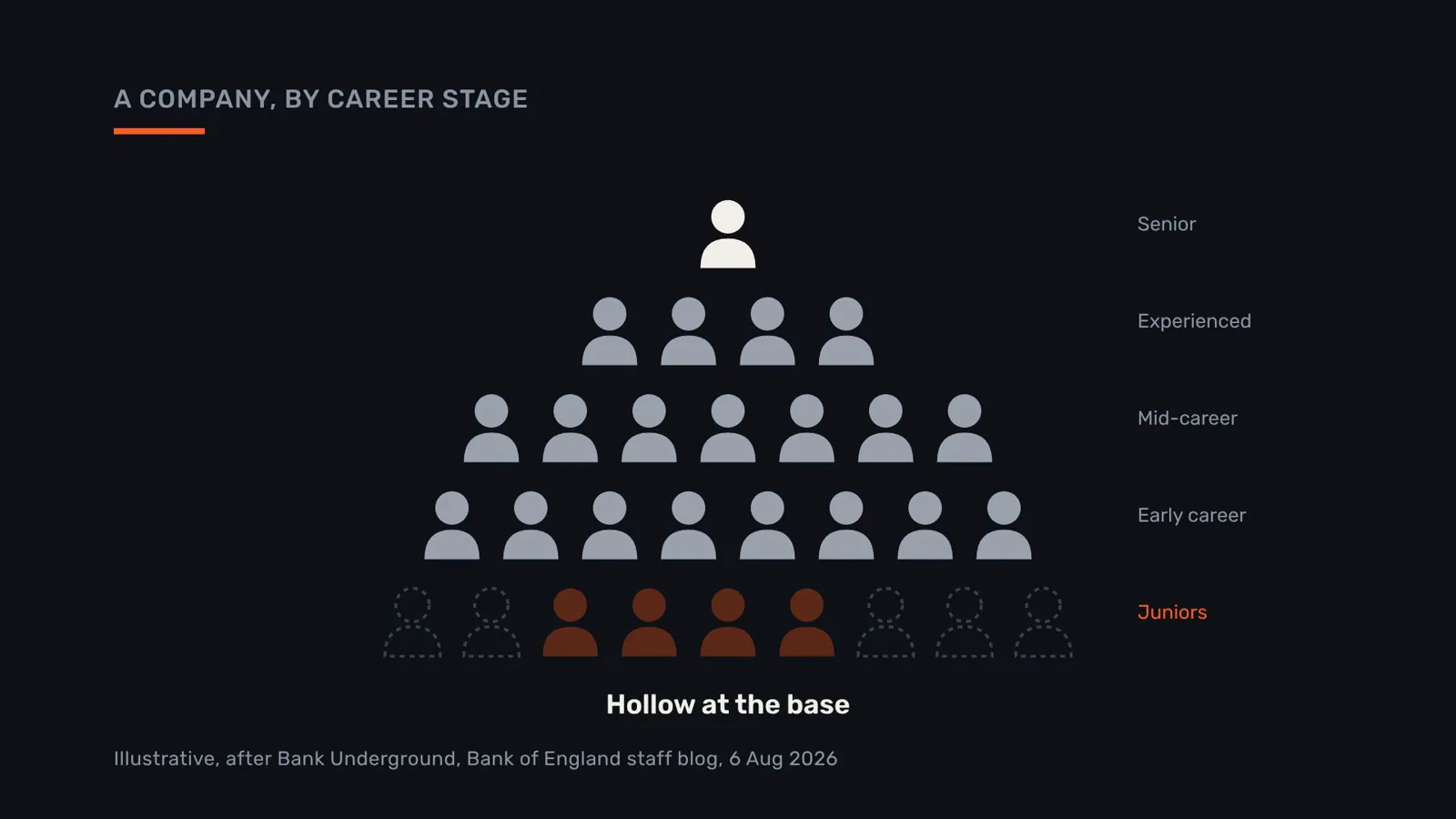
A Bank of England staff blog drew the picture: "The traditional pyramid structure, built on large cohorts of junior workers, may be oscillating toward a diamond, hollow at the base and centred on experienced staff" 48. Don't watch the layoffs. Watch the hiring.
Timeline
| Date | Event |
|---|---|
| Feb 2022 | Indeed software postings peak at 233.9 51 |
| 30 Nov 2022 | ChatGPT released; software postings already down to 142.5 51 |
| 27 Feb 2024 | Klarna: AI assistant does "the equivalent work of 700 full-time agents" 38 |
| 7 Apr 2025 | Shopify memo: show AI can't do it before asking for headcount 32 |
| Apr 2025 | Duolingo's "AI-first" memo; UK employer National Insurance rises to 15% 33,55 |
| May 2025 | Klarna's chief executive: "what you end up having is lower quality" 35 |
| 17 Jun 2025 | Jassy memo: AI will "reduce our total corporate workforce" 18 |
| Late Oct 2025 | Amazon cuts about 14,000; Jassy: "it's culture" 19 |
| 26 Nov 2025 | Fed Beige Book: AI "replaced entry-level positions" at a few firms 30 |
| 26 Feb 2026 | Block cuts over 4,000: "our business is strong" 21 |
| Mar 2026 | AI becomes the top stated reason for US cuts for the first time 4 |
| 23 Apr 2026 | Meta cuts about 8,000 jobs and closes about 6,000 open roles 25 |
| May 2026 | AI-cited cuts peak at 38,579, 40% of the month 5 |
| 12 Aug 2026 | Stanford's revised paper: a 19% gap for young workers, through hiring 8 |
| Sep 2026 | Lambert and Schindler's remote-work paper; Yale finds no clear disruption 50,9 |
| 1 Oct 2026 | Challenger: AI fifth in September, still first year to date at 120,136 1 |
Sources
- Challenger, Gray & Christmas, Challenger Report, September 2026, 1 Oct 2026. https://www.challengergray.com/wp-content/uploads/2026/10/Challenger-Report-September-2026.pdf
- Challenger, Gray & Christmas, Challenger Report, January 2026, 5 Feb 2026. https://www.challengergray.com/wp-content/uploads/2026/02/CR126007123.pdf
- Challenger, Gray & Christmas, Challenger Report, February 2026, 5 Mar 2026. https://www.challengergray.com/wp-content/uploads/2026/03/CR22678739921002.pdf
- Challenger, Gray & Christmas, Challenger Report, May 2026 ("AI drives May cuts… AI leads reasons for third month in a row"), 4 Jun 2026. https://www.challengergray.com/wp-content/uploads/2026/06/Challenger-Report-May-2026.pdf
- Challenger, Challenger Report, May 2026, 4 Jun 2026. https://www.challengergray.com/wp-content/uploads/2026/06/Challenger-Report-May-2026.pdf
- Challenger via Dow Jones/Morningstar, Challenger Report, September 2026 (released 1 Oct 2026); news write-up, 1 Oct 2026. https://www.morningstar.com/news/dow-jones/202610012110/us-employer-layoff-plans-fall-in-september-challenger-says (PDF via challengergray.com blog)
- Stanford Digital Economy Lab, Canaries in the Coal Mine? (Aug 2026 revision), Aug 2026. https://digitaleconomy.stanford.edu/app/uploads/2026/08/Canaries_August2026.pdf
- Stanford DEL, No Widespread Displacement, but the AI Employment Gap… 19%, 12 Aug 2026. https://digitaleconomy.stanford.edu/news/canariesaug26/
- Yale Budget Lab, Tracking the Impact of AI on the Labor Market, 15 Sep 2026. https://budgetlab.yale.edu/research/tracking-impact-ai-labor-market
- Fortune (Sasha Rogelberg), If AI is roiling the job market, the data isn't showing it, Yale Budget Lab report says..., 2 Feb 2026. https://fortune.com/2026/02/02/ai-labor-market-yale-budget-lab-ai-washing/
- Chicago Fed, Rethinking Automation Risk (WP 2026-12), 2 Jul 2026. https://www.chicagofed.org/-/media/publications/working-papers/2026/wp2026-12.pdf
- NBER, Firm Data on AI (NBER w34836), Feb–Mar 2026. https://www.nber.org/papers/w34836
- MIT FutureTech, Crashing Waves vs. Rising Tides, Apr/Jul 2026. https://arxiv.org/abs/2604.01363
- MIT / ORNL, The Iceberg Index, Nov 2025. https://arxiv.org/pdf/2510.25137
- Challenger, Challenger Report, July 2026, 6 Aug 2026. https://www.challengergray.com/wp-content/uploads/2026/08/Challenger-Report-July-2026.pdf
- Oxford Economics (Anusha Suthenthiran), Evidence of an AI-driven shakeup of job markets is patchy (Research Briefing), 7 Jan 2026. https://www.oxfordeconomics.com/resource/evidence-of-an-ai-driven-shakeup-of-job-markets-is-patchy/
- Fortune (Nick Lichtenberg), AI layoffs are looking more and more like corporate fiction..., 7 Jan 2026. https://fortune.com/2026/01/07/ai-layoffs-convenient-corporate-fiction-true-false-oxford-economics-productivity/
- Amazon, Jassy: some thoughts on generative AI, 17 Jun 2025. https://www.aboutamazon.com/news/company-news/amazon-ceo-andy-jassy-on-generative-ai
- Fortune, Jassy: layoffs about culture, not AI, 1 Nov 2025. https://fortune.com/2025/11/01/ceo-andy-jassy-amazon-layoffs-about-culture-not-ai
- GeekWire, Amazon confirms 16,000 more job cuts, bringing total to 30,000 since October, 28 Jan 2026. https://geekwire.com/2026/amazon-confirms-16000-more-job-cuts-bringing-total-layoffs-to-30000-since-october/
- Daring Fireball, Block layoffs (Dorsey memo), 27 Feb 2026. https://daringfireball.net/linked/2026/02/27/block-layoffs
- Storyboard18, Block layoffs: AI shift or "AI washing"?, Mar 2026. https://storyboard18.com/brand-makers/block-inc-layoffs-ai-shift-or-ai-washing-behind-jack-dorseys-4000-job-cuts-91644.htm
- Cointelegraph, Block rehires some staff initially fired, 19 Mar 2026. https://cointelegraph.com/news/block-rehires-some-staff-initially-fired
- Bloomberg Law, Dorsey's 4,000 job cuts at Block arouse suspicions of AI-washing, 1 Mar 2026. https://news.bloomberglaw.com/daily-labor-report/dorseys-4-000-job-cuts-at-block-arouse-suspicions-of-ai-washing
- AP via ABC7, Meta to cut 8,000 jobs, 24 Apr 2026. https://abc7news.com/post/meta-cut-8000-jobs-10-staff-pours-billions-ai/18956199/
- Fortune, Benioff on AI agents and layoffs, 2 Sep 2025. https://fortune.com/2025/09/02/salesforce-ceo-billionaire-marc-benioff-ai-agents-jobs-layoffs-customer-service-sales
- Storyboard18, Salesforce cuts 4,000 support roles for AI but plans to hire 5,000 sales staff, 20 Oct 2025. https://www.storyboard18.com/brand-makers/salesforce-cuts-4000-support-roles-for-ai-but-plans-to-hire-5000-sales-staff-says-ceo-marc-benioff-82829.htm
- US Census Bureau (Tucker), You're (not) Hired, Apr 2026. https://www2.census.gov/library/working-papers/2026/adrm/ces/CES-WP-26-27.pdf
- NY Fed, Labor Market for Recent College Graduates, Aug 2026. https://www.newyorkfed.org/research/college-labor-market
- Federal Reserve, Beige Book summary, 26 Nov 2025. https://www.federalreserve.gov/monetarypolicy/beigebook202511-summary.htm
- Federal Reserve, Barr speech, 17 Feb 2026. https://www.federalreserve.gov/newsevents/speech/files/barr20260217a.pdf
- TechCrunch, Shopify CEO memo, 7 Apr 2025. https://techcrunch.com/2025/04/07/shopify-ceo-tells-teams-to-consider-using-ai-before-growing-headcount
- TechRepublic, Duolingo to replace human contractors with bots, become "AI-first", 29 Apr 2025. https://www.techrepublic.com/article/news-duolingo-replaces-contractors-ai/
- Fortune (citing NYT), Duolingo CEO admits AI memo did not give enough context, 18 Aug 2025. https://fortune.com/2025/08/18/duolingo-ceo-admits-controversial-ai-memo-did-not-give-enough-context-insists-company-never-laid-off-full-time-employees
- Fortune, Klarna, AI, humans and ROI, 9 May 2025. https://www.fortune.com/2025/05/09/klarna-ai-humans-return-on-investment
- Prolific North (citing FT), Klarna could cut half of 3,800 jobs as it looks to AI, 28 Aug 2024. https://www.prolificnorth.co.uk/news/klarna-could-cut-half-of-jobs-as-it-looks-to-ai-to-boost-ipo/
- Fortune, Klarna's CEO on AI and workforce shrinkage, 17 Feb 2026. https://fortune.com/2026/02/17/klarnas-ceo-dario-amodei-ai-white-collar-workforce-shrink-2030
- Klarna, Klarna press release: AI assistant handles two-thirds of chats, 27 Feb 2024. https://www.klarna.com/international/press/klarna-ai-assistant-handles-two-thirds-of-customer-service-chats-in-its-first-month/
- Entrepreneur (citing Bloomberg), "Klarna is hiring customer service agents after AI couldn't cut it", 9 May 2025. https://www.entrepreneur.com/business-news/klarna-ceo-reverses-course-by-hiring-more-humans-not-ai/491396
- GIGAZINE (citing WSJ), IBM's CEO says AI replaced hundreds of HR staff, but programmers and salespeople increased, 8 May 2025. https://gigazine.net/gsc_news/en/20250508-ibm-ceo-ai-replaced-workers
- People Matters (citing WSJ), IBM CEO says replacing HR staff with AI led to more hiring, 7 May 2025. https://www.peoplematters.in/news/leadership/ibm-ceo-says-replacing-hr-staff-with-ai-led-to-more-hiring-45453
- Work Foundation, Lancaster, First steps, 26 Aug 2026. https://www.lancaster.ac.uk/work-foundation/our-work/insecure-work/first-steps
- Reuters (David Milliken), via Zawya, One in three UK employers have cut entry-level jobs, survey shows, 26 Aug 2026. https://www.zawya.com/en/world/global/one-in-three-uk-employers-have-cut-entry-level-jobs-survey-shows-467391
- IBTimes UK, Graduate Job Vacancies Plunge to 8,383, Reaching a Ten-Year Low..., 25 Aug 2026. https://www.ibtimes.co.uk/uk-graduate-job-vacancies-record-low-july-1816237
- The London Economic (Charlie Herbert), Graduate jobs drop by almost 50% in a year..., 24 Aug 2026. https://thelondoneconomic.com/news/graduate-jobs-drop-by-almost-50-in-a-year-as-employers-replace-entry-level-roles-with-ai-409115/
- Prospects Luminate / Jisc (Charlie Ball), Is this really the worst graduate labour market on record?, Sep 2026. https://luminate.prospects.ac.uk/is-this-really-the-worst-graduate-labour-market-on-record
- Institute of Student Employers (Stephen Isherwood), ISE response to Adzuna graduate vacancy figures, 25 Aug 2026. https://ise.org.uk/knowledge/insights/594/ise_response_to_adzuna_graduate_vacancy_figures
- Bank Underground (BoE staff), Canaries in the column?, 6 Aug 2026. https://bankunderground.co.uk/2026/08/06/canaries-in-the-column-ai-exposure-and-the-uks-hiring-slowdown/
- HRreview, AI set to displace jobs, Bank of England Governor warns... (BBC Radio 4 Today interview), 22 Dec 2025. https://hrreview.co.uk/?p=385541
- RFBerlin (Lambert, Schindler), The Broken Ladder, Sep 2026. https://www.rfberlin.com/wp-content/uploads/2026/08/26228.pdf
- Indeed Hiring Lab via FRED, Indeed Job Postings Index: Software Development (IHLIDXUSTPSOFTDEVE), plus total, nursing and customer service series, daily to 2 Oct 2026. https://fred.stlouisfed.org/series/IHLIDXUSTPSOFTDEVE
- SignalFire, SignalFire State of Talent Report 2026, 22 Jun 2026. https://signalfire.com/blog/signalfire-state-of-talent-report-2026
- SignalFire, SignalFire State of Tech Talent Report 2025, 20 May 2025. https://www.signalfire.com/blog/signalfire-state-of-talent-report-2025
- GOV.UK, National Minimum Wage and National Living Wage rates, current. https://www.gov.uk/national-minimum-wage-rates
- HM Treasury / GOV.UK, Autumn Budget 2024, Annex A: rates and allowances, Oct 2024. https://www.gov.uk/government/publications/autumn-budget-2024-overview-of-tax-legislation-and-rates-ootlar/annex-a-rates-and-allowances
- Harvard Business Review (Davenport and Srinivasan), Companies are laying off workers because of AI's potential, not its performance, 29 Jan 2026. https://hbr.org/2026/01/companies-are-laying-off-workers-because-of-ais-potential-not-its-performance
- Above the Law, Stats of the week: is FOMO fuelling layoffs?, Mar 2026. https://abovethelaw.com/2026/03/stats-of-the-week-is-fomo-fueling-layoffs/
- Stanford Digital Economy Lab, Canaries, interest rates and timing: more on recent drivers of employment changes for young workers, 9 Feb 2026. https://digitaleconomy.stanford.edu/news/canaries-interest-rates-and-timinga-more-on-recent-drivers-of-employment-changes-for-young-workers
Also behind the film
Sources for facts in the documentary that this article does not cite.
- MIT Sloan Ideas Made to Matter (Seb Murray), How will AI automation hit: a crashing wave or a rising tide?, 5 Aug 2026. https://mitsloan.mit.edu/ideas-made-to-matter/how-will-ai-automation-hit-a-crashing-wave-or-a-rising-tide
- Sam Altman on AI-washing: CNBC-TV18, "AI Impact Summit 2026. https://www.youtube.com/watch?v=b-fvYNpTris
- Implicator.ai (from CNBC-TV18, India AI Impact Summit), "Sam Altman says companies 'AI-wash' layoffs", 22 Feb 2026. https://www.implicator.ai/sam-altman-says-companies-ai-wash-layoffs-while-under-1-of-job-losses-trace-to-ai.md
- Fortune Europe, Klarna's AI chatbot does work of 700 full-time staff, 28 Feb 2024. https://fortune.com/europe/2024/02/28/klarna-ai-altered-hiring-chatbot-700-full-time-staff-openai
- Microsoft Research (Tomlinson, Jaffe, Wang, Counts, Suri), Working with AI: Measuring the Applicability of Generative AI to Occupations (arXiv 2507.07935), 10 Jul 2025. https://arxiv.org/abs/2507.07935
- Microsoft Research (Tomlinson, Jaffe, Wang, Counts, Suri), Working with AI: Measuring the Applicability of Generative AI to Occupations (v6), v1 Jul 2025; v6 22 Dec 2025. https://arxiv.org/abs/2507.07935
- MIT FutureTech, Crashing Waves vs Rising Tides (MIT FutureTech, Mertens, Thompson et al.), page and PDF, 21 Jul 2026 (prelim. Apr 2026). https://futuretech.mit.edu/publication/crashing-waves-vs-rising-tides-preliminary-findings-on-ai-automation-from-thousands-of-worker-evaluations-of-labor-market-tasks
- Indeed Hiring Lab, AI and Job Postings: From Destruction to Creation?, 8 Jul 2026. https://hiringlab.indeed.com/2026/07/08/ai-and-job-postings-from-destruction-to-creation/
This article accompanies the /SHIFT episode of the same name. Layoff, unemployment and job-advert figures are as published by 14 October 2026, and several are revised monthly. Challenger's counts record the reasons companies give for announced cuts, not measured job losses.